What Does a Dental Implant Include at Clínica DrDiente?
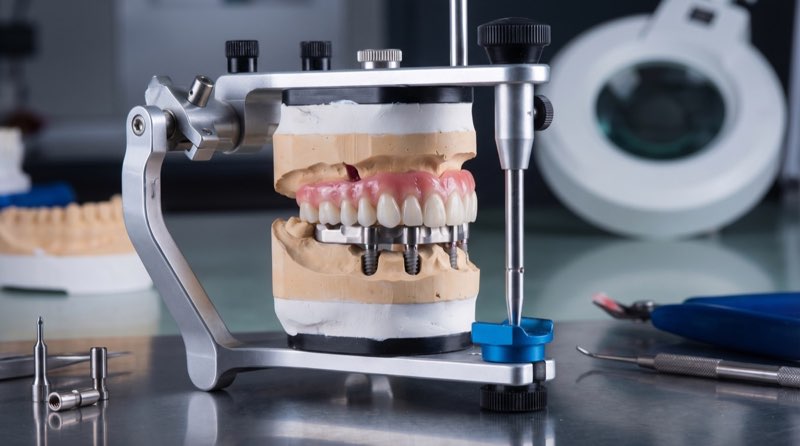
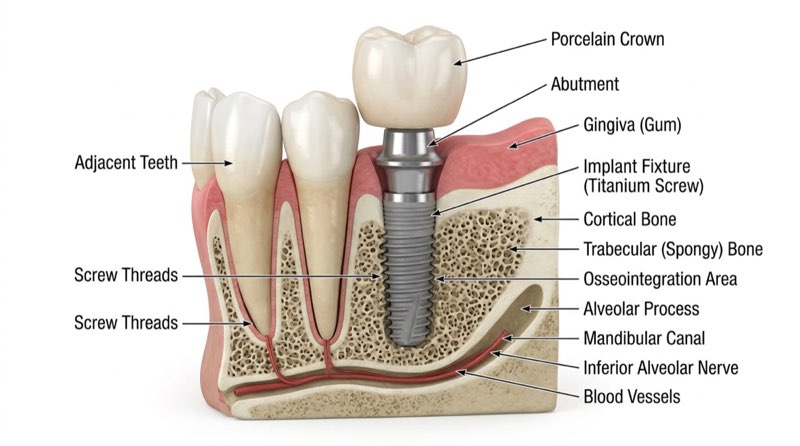
At Clínica DrDiente, a dental implant is a complete solution — not just a titanium screw. From your very first visit at our locations in Roma Norte or Polanco, CDMX, the protocol includes 3D cone-beam tomography to map your bone, intraoral digital scanning, computerized surgical planning, the implant fixture, the abutment connector, and the final ceramic or zirconia crown — all coordinated under one roof. I'm Dr. Carlos Ariza, and after 15 years placing implants in Mexico City, I can tell you the difference between a complete protocol and a shortcut is enormous. You notice it later — specifically when something starts failing five years in.
In simple terms: you leave with a tooth that looks, feels, and chews like a natural one. Our implant protocol at DrDiente documents every step digitally, so there are no guesses and no surprises.
There is something about implant pricing in CDMX that most clinics will not explain during your first consultation — and it directly determines whether your case ends up at the low end of the cost range or significantly higher for the exact same functional result. I will break that down right now.
How Much Does a Dental Implant Cost in CDMX? — Real 2026 Prices
The honest answer: it depends on your specific case. But here are real numbers, not marketing language.
A single implant with ceramic crown in CDMX ranges from $15,000 to $45,000 MXN. That spread exists because three things drive the price: the implant brand and its documented long-term track record, the complexity of your bone anatomy, and whether additional procedures like a bone graft or sinus lift are required.
- Economy brands (Asian-manufactured systems): $10,000–$18,000 MXN — lower upfront cost, limited long-term clinical data
- Mid-range systems (Neodent, MIS): $18,000–$30,000 MXN — solid clinical evidence, good cost-benefit ratio
- Premium systems (Straumann, Nobel Biocare): $30,000–$55,000 MXN — gold standard, 95–98% survival rate at 10 years
- All-on-4 full arch rehabilitation: $80,000–$180,000 MXN per arch
To be honest: a complete implant — fixture, abutment, and crown — advertised under $10,000 MXN is a real red flag. It almost always means skipped steps, no 3D tomography, or unverified implant materials. Fixing a failed implant costs two to three times what a proper one would have cost initially.
At DrDiente, every case starts with an evaluation and an exact quote for your specific anatomy. We offer 6 to 24-month financing plans, with monthly payments starting around $1,200–$3,000 MXN. Patients visiting from outside Mexico City or from abroad can use our dental tourism CDMX program, which includes bilingual coordination and remote follow-up.
Before you decide whether this is right for you, there is a complication that affects roughly 30–40% of patients I evaluate on their first visit. Most have no idea it applies to them until I show them the 3D scan. It changes both the timeline and the total cost significantly. Here is what you need to know.
How Do I Know if I'm the Ideal Candidate?
The short answer: most adults missing one or more teeth are candidates. But the evaluation findings are different for every patient, and that is where the real answer lives.
You are likely a strong candidate if you have adequate bone volume, healthy gums with no active infection, no uncontrolled systemic conditions — uncontrolled diabetes or IV bisphosphonate therapy are absolute contraindications — and realistic expectations about a multi-month process. Non-smokers and light smokers show significantly better outcomes. Heavy smoking, over 20 cigarettes per day, brings implant survival rates down to approximately 85%, which changes the clinical conversation considerably.
The complication I mentioned: bone resorption. When a tooth is missing for more than a year, the jaw bone in that area begins to shrink — the body stops maintaining bone where no tooth root provides stimulation. Think of it like a muscle that atrophies when it stops being used. I see this in 30–40% of new evaluations. In those cases, a bone graft is required before or alongside the implant, adding 3–6 months and $8,000–$20,000 MXN to the total cost.
Not a dealbreaker. But something you deserve to know before walking in expecting a single-session procedure.
Is it normal to have been putting this off for years? In my clinic, most patients have. Often because a previous dentist gave incomplete information, or because nobody took the time to show them what their actual bone situation looked like on a 3D scan. That is exactly what our evaluation and imaging protocol fix: you leave knowing precisely what your case requires, what it costs, and what the timeline is.
Once we confirm your case is ready, the next thing people worry about is the surgical phase itself. What actually happens in the procedure room surprises almost every patient — and usually in a very good way.
Step-by-Step Process at DrDiente
Step 1 — Evaluation and 3D tomography. I assess your bone volume, gum health, and bite. Our cone-beam CT scanner produces a full volumetric map of your jaw — not a flat panoramic X-ray, but a 3D image showing bone density, width, and height in three dimensions. I plan the implant position, angle, and depth digitally before any procedure begins.
Step 2 — Digital treatment planning. Using our intraoral scanner and 3D planning software, I design your case on screen. If you are also a candidate for smile design, we plan the full esthetic result at this stage too. You see what the final outcome looks like before we touch anything.
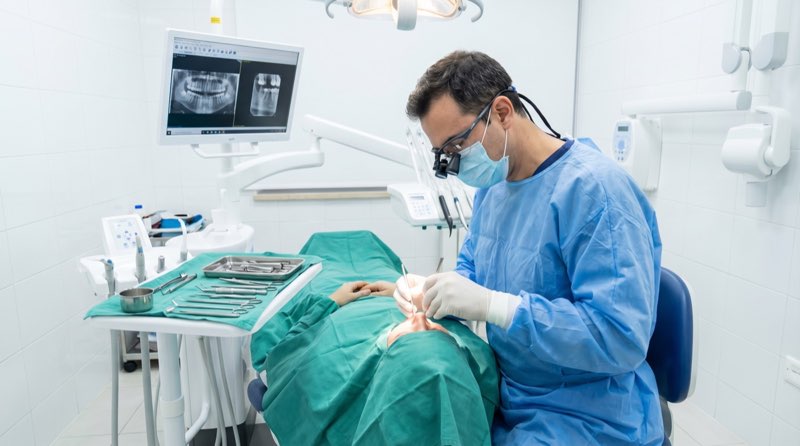
Step 3 — Surgical placement. Under local anesthesia, I place the titanium fixture into the bone. The procedure takes 30–60 minutes per implant. Most patients are genuinely surprised by how calm the experience is — complete anesthesia, controlled environment, no rushing. The technology-guided approach means precision, not guesswork.
Step 4 — Osseointegration period. Over 3 to 6 months, your bone fuses with the implant surface at a microscopic level — the titanium integrates with living tissue, creating a permanent biological anchor. A temporary tooth fills the space during this phase so there is no visible gap.
Step 5 — Final crown placement. Once integrated, I place the abutment and take a digital impression. Our in-house dental lab fabricates the permanent crown to exact specifications — color, shape, and occlusal contact calibrated to match your natural teeth. The final result should look like a tooth you were born with. If it looks artificial or square, something went wrong.
Step 6 — Ongoing maintenance. Professional cleaning every 6 months is non-negotiable. Without it, peri-implantitis — a bacterial infection around the implant site — can develop. It affects approximately 22% of implants at 10 years in patients who skip professional maintenance. The implant survives surgery. What threatens it long-term is neglecting the tissue around it.
Questions I Always Get Before Booking
Does getting a dental implant hurt?
The surgery itself: no. The anesthesia is complete and patients feel pressure, not pain. The 24–48 hours post-surgery involve mild soreness, easily managed with ibuprofen. In my experience, the procedure is almost always far less uncomfortable than patients imagined it would be. The fear is real. The actual pain, for most people, is not.
How long does the entire process take from start to finish?
In standard cases without bone grafting: 4 to 8 months from evaluation to final crown. With a prior graft: add 3–6 months. In select cases with sufficient bone volume, immediate loading — a provisional crown placed the same day as surgery — is clinically possible. I assess this individually every time, not as a default offer.
How long does a dental implant actually last?
With consistent maintenance: a lifetime. Clinical studies report 93–98% survival rates at 10–15 years. The ceramic crown on top may need replacement after 15–20 years of normal wear. The titanium root, once integrated with the bone, remains permanently. Compare that to a dental bridge: a 10–15 year average lifespan, with two healthy adjacent teeth ground down to accommodate it.
Is the investment really worth it compared to a bridge or dentures?
For most patients, yes — and I say that as someone who evaluates the full clinical picture, not just the aesthetics. A bridge compromises two structurally healthy teeth. Removable dentures reduce chewing efficiency and accelerate bone loss underneath them over time. An implant preserves bone volume, functions identically to a natural tooth, and leaves neighboring teeth completely untouched. The key is matching the right solution to your specific anatomy, health history, and budget — which is exactly what the evaluation is designed to determine.
Why Patients from All Over CDMX Choose DrDiente?
After 15 years placing implants in Mexico City, I have also corrected cases that failed elsewhere — implants placed without 3D imaging, with off-brand fixtures carrying no long-term clinical data, or with crowns that fit poorly and caused chronic inflammation around the implant site for years. What makes Clínica DrDiente different is not a single feature. It is the full protocol, applied consistently on every case.
We work with premium implant systems that have documented international track records. Our 3D cone-beam CT and intraoral scanning technology are not marketing tools — they are how I actually plan every placement. Our in-house digital lab means your final crown is fabricated to my exact specifications, not sent to an outside lab with generic measurements and returned weeks later.
Both our Roma Norte and Polanco, CDMX locations use the same technology and follow the same clinical protocol. Whether you are a local patient or traveling for dental tourism in CDMX from the United States, Canada, or anywhere else in Mexico, you receive the same standard of care with full bilingual coordination from consultation to final follow-up.
And when a case is not ready for an implant — when the gum tissue needs treatment first, when the bone requires grafting, when the honest clinical answer is different from what the patient expected — I say so clearly. Every time. That is the only way I know how to practice.
See real implant cases: before and after results at DrDiente
Schedule your evaluation — no commitment required
Your in-person assessment in Mexico City
Roma Norte: $2,125 MXN, including tomography. Choose a location to request availability and discuss a plan for your case.
Roma Norte location and visiting information
Information from Clínica DrDiente
Aesthetic Dentistry & Oral Rehabilitation · COFEPRIS 2409132002A00145
This content is informational and is not a substitute for professional dental advice. Book an assessment for a personalized diagnosis.