What Does All-on-4 Include at Clínica DrDiente?
The short answer: everything you need to go from missing or failing teeth to a full, fixed smile — in a single surgical day. At Clínica DrDiente, our All-on-4 protocol covers a comprehensive digital evaluation, a cone-beam 3D CT scan, surgical placement of four implants per arch, and immediate loading with a fixed provisional prosthesis within 24 to 72 hours. I am Dr. Carlos Ariza, and after 15 years in practice across our clinics in Roma Norte and Polanco, CDMX, this procedure remains one of the most transformative things I offer my patients.
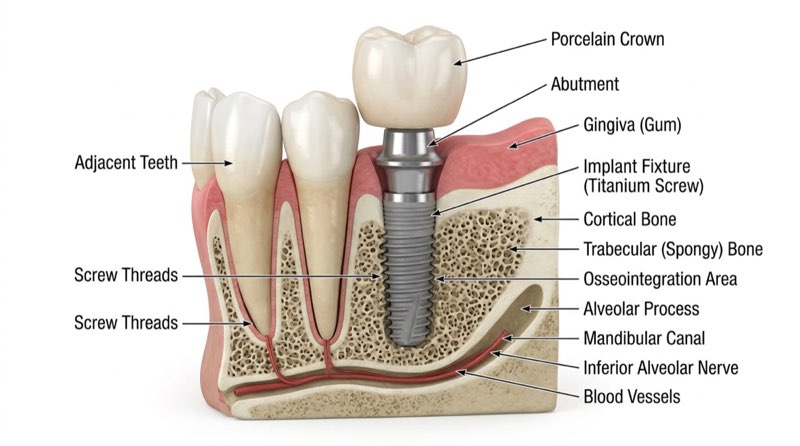
The geometry is what makes it work. Two implants go in straight at the front of the arch; two go in at an angle — typically 30 to 45 degrees — at the back. That angulation lets us anchor into available bone without requiring grafts in most cases. In simple terms: you skip months of bone graft healing and leave the clinic with a complete set of fixed teeth the same day you have surgery.
There is something most dentists do not tell you in that first consultation, and I want to be upfront about it: the teeth you go home with on surgery day are a high-quality provisional, not your final prosthesis. What happens over the next four to six months — and the material your definitive restoration is made from — matters enormously for long-term results. I will explain exactly why in the process section below.
How Much Does All-on-4 Cost in CDMX? — Real Prices 2026
Let me give you honest numbers. At Clínica DrDiente, an All-on-4 hybrid prosthesis ranges from $95,000 to $160,000 MXN per arch. The range exists because cost depends on the implant brand (we use Nobel Biocare and Straumann — Tier-1 systems with decades of clinical evidence), the type of final prosthesis, and the complexity of your individual anatomy.
For comparison: the same procedure in the United States runs $20,000 to $30,000 USD per arch. Patients who travel to CDMX for dental tourism in Mexico City typically save 60 to 75 percent — even after flights and accommodation. That is not a marketing figure; it reflects the structural cost difference between healthcare systems while using identical implant brands and protocols.
What is included in our quoted price at DrDiente:
- Cone-beam CT scan and full digital treatment planning
- Surgical placement of four implants per arch
- Immediate provisional fixed prosthesis
- Follow-up appointments through the integration period
The final zirconia prosthesis is quoted separately after we review your scan — and if you are wondering why that material distinction matters so much, the process section covers it in detail. We also offer an initial evaluation and financing plans with participating banks so you can see real numbers before making any commitment.
How Do I Know If I Am the Right Candidate?
Depends on several factors, but here is how I evaluate it in my practice. The ideal All-on-4 candidate has lost most or all teeth in one or both arches, has sufficient residual bone volume to anchor four implants without major grafting, and is in stable systemic health. Bone loss alone does not disqualify you — the angulated posterior implant design exists precisely to work around significant resorption.
I have seen patients arrive after being told by another clinic that they did not have enough bone for implants. After a proper 3D scan, many of them were solid candidates. The CBCT does not lie. This is why at DrDiente, no diagnosis and no treatment plan is made without imaging first. That step is non-negotiable.
Real contraindications exist, and I will always be honest about them:
- Uncontrolled bruxism — severe grinding places damaging forces on a fixed prosthesis and must be managed before any implant work
- Uncontrolled diabetes — impaired healing significantly raises implant failure risk
- Recent radiation therapy to the head and neck region
- Active heavy smoking — studies confirm tobacco reduces implant survival rates by up to 25 percent
Now, here is the exception worth knowing if you have advanced bone resorption or are over 55: in my experience, these cases sometimes require an All-on-6 configuration — six implants instead of four — particularly in the upper arch, where bone density tends to be lower and occlusal forces distribute differently. A small number of cases with extreme maxillary atrophy call for zygomatic implants altogether. Our digital planning technology is what determines the right protocol for your specific anatomy before any surgery is scheduled.
Step-by-Step Process at DrDiente
There is no guesswork in this procedure. Everything is mapped digitally before we touch anything. Here is what the full process looks like from first contact to final smile:
Step 1 — Evaluation and CBCT scan. We image your jaw in three dimensions. I am analyzing bone density, nerve position, sinus proximity — everything that determines implant placement and angulation. Your case is then run through planning software to position the implants virtually before surgery happens in reality.
Step 2 — Treatment plan review. I walk you through the digital plan: proposed implant positions, projected prosthesis shape, and the full timeline. No surprises later.
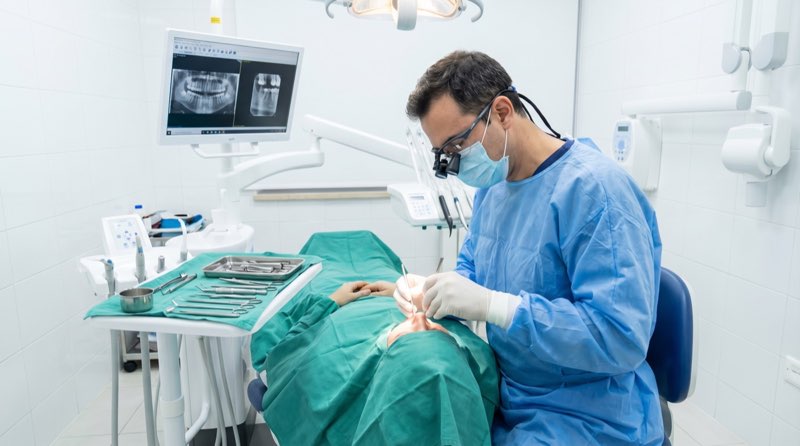
Step 3 — Surgery day. Two to four hours under local anesthesia, with sedation available. Four implants placed. Same day, you receive a fixed provisional prosthesis. Not removable. Fixed.
Step 4 — Integration period (4 to 6 months). Osseointegration — your bone fuses around the implant surface. You eat, speak, and live normally during this phase. I see you at scheduled checkpoints throughout.
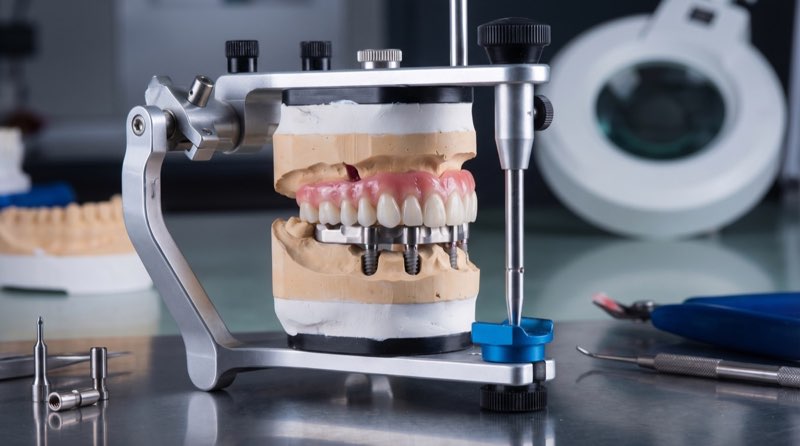
Step 5 — Final prosthesis. This is where our in-house digital lab makes the real difference. Your definitive restoration — monolithic zirconia in most cases — is designed and milled here, under the same roof as the surgical team. Zirconia handles bite forces far better than acrylic over the long term. I have seen acrylic temporaries fracture in patients with strong occlusal patterns; zirconia behaves differently. And because our ceramist and surgeon collaborate directly, the final fit matches the digital plan with precision. The result looks natural — teeth with curves, texture, and proper proportion. Not artificial-looking uniform squares. Natural, individualized.
After your final prosthesis is placed, maintenance is straightforward: professional dental cleanings every 4 to 6 months and daily oral irrigation with a Waterpik. Peri-implantitis — infection around the implant — is the primary cause of late implant failure and is almost entirely preventable with a consistent hygiene routine.
Questions I Always Get Before Patients Book
Does the All-on-4 surgery hurt?
The procedure is done under local anesthesia — no pain during surgery. Postoperative swelling and soreness are normal for 3 to 5 days and are managed with standard anti-inflammatory medication. Most patients tell me the recovery was far more manageable than they had imagined going in.
How long do All-on-4 implants actually last?
Long-term clinical studies report a 94 to 98 percent implant survival rate at 10 years, with 15-year follow-up data from the Bränemark Institute showing comparable results. The prosthesis lifespan depends on material: acrylic restorations may need replacement after a few years; a zirconia final prosthesis, properly maintained, lasts 15 to 20 years.
How long is the total treatment from surgery to final teeth?
Four to six months total — but you have fixed, functional teeth from day one. The wait is for osseointegration, not for function or aesthetics. You are never without teeth during this process.
Does DrDiente offer a guarantee?
Yes — a written warranty on both the implants and the prosthesis. It is conditional on follow-up maintenance, regular cleanings, and no smoking through the integration period. We are transparent about those terms before treatment starts, not after the fact.
Can I travel from the U.S. or Canada and get this done in one trip?
For the surgical phase, yes. Most international patients complete surgery and receive the provisional prosthesis in a single visit of 5 to 7 days. The final prosthesis fitting, 4 to 6 months later, ideally requires a return trip. We have a structured protocol for international patients — dental tourism in CDMX is a well-organized part of what we do at DrDiente, not an afterthought.
Why Patients from All Over CDMX — and Beyond — Choose DrDiente
Let me be direct about what sets this clinic apart.
The diagnostic technology is not an optional upgrade here. Every All-on-4 case at Clínica DrDiente goes through a 3D scan and complete digital planning before any surgery. The clinical data that gives this procedure its 94-plus percent survival rates comes from exactly this level of precision. It is the standard I hold at both our Roma Norte and Polanco, CDMX locations — because it is what the evidence shows produces consistent outcomes.
The in-house digital lab is a real differentiator. Most clinics outsource prosthetic fabrication to external labs. We do not. Our ceramist and implant surgeon work under the same roof — tighter tolerances, direct communication, and a final restoration that matches what was planned digitally. That translates into fit, function, and aesthetics that hold up over time. It also means the work looks like teeth, not like dental work.
In my experience, the patients who end up disappointed with their All-on-4 outcome almost always chose based on the lowest quote rather than on protocol quality. I have treated patients who came to me after implant failure elsewhere — cases placed without adequate CBCT planning, with budget implant systems, without proper angulation technique. Reconstruction after failure is significantly more complex and more expensive than doing it right the first time. That is the honest reality of this field, and I think you deserve to know it before you decide.
If you are evaluating dental implants in CDMX or planning a dental tourism trip to Mexico City, we are ready to give you a real diagnosis — no pressure, no obligation. Fifteen years of experience. Two clinical locations. A digital lab on-site. That is what we bring to every case.
See real All-on-4 before and after cases at DrDiente I want my evaluation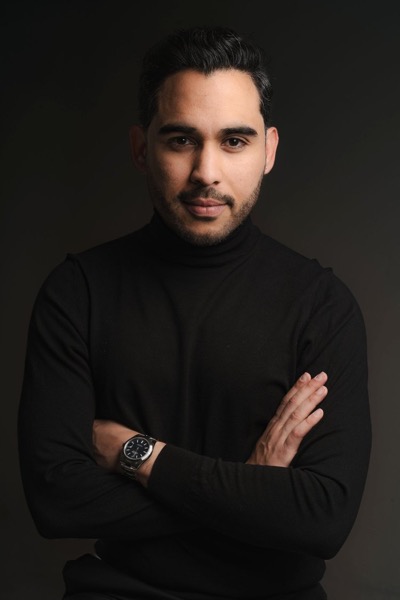
Information from Clínica DrDiente
Aesthetic Dentistry & Oral Rehabilitation · COFEPRIS 2409132002A00145
This content is informational and is not a substitute for professional dental advice. Book an assessment for a personalized diagnosis.