
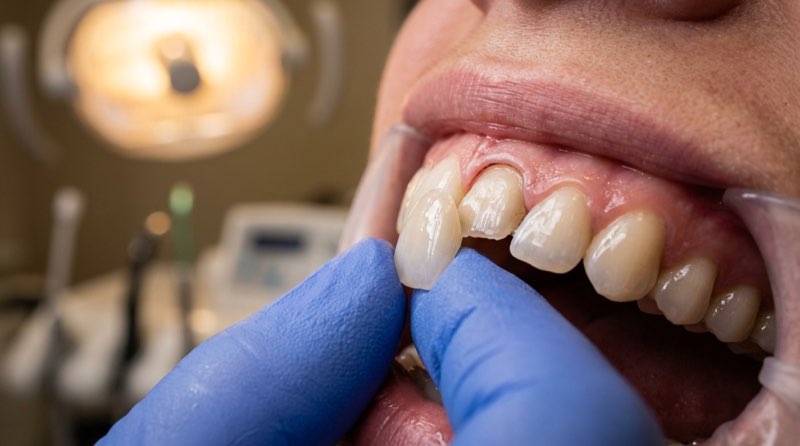
Why Do Dental Veneers Smell Bad? — The Direct Answer
The short answer is this: a properly made veneer does not smell. I get asked this constantly at Clínica DrDiente in CDMX, and the answer is always the same. When a veneer causes bad breath, the culprit is almost never the veneer material itself — it is what is happening at the margin between the veneer and the tooth. At our clinics in Roma Norte and Polanco, the first thing I, Dr. Carlos Ariza, evaluate is whether there is a marginal gap, secondary decay, or inflamed gum tissue hiding underneath.
Why Does This Matter for Your Dental Health?
Bad breath from a veneer is not just a cosmetic nuisance. In my 15 years of clinical experience, I have seen patients live with this problem for months convinced it was "just how veneers are." It is not. When bacteria colonize a failing veneer margin, they produce volatile sulfur compounds (VSC) — the same molecules responsible for the smell of rotten eggs. That means the odor is a symptom. Beneath it, there is active bacterial activity that can lead to secondary decay, gum inflammation, or even bone loss if left untreated.
The good news: once you identify the actual cause, the solution is almost always simpler than patients expect.
There is something most dentists will not tell you at the first consultation — and it changes how you should think about veneer maintenance entirely. I will explain it in a moment.
The Four Real Causes of Veneer Odor
In practice, I see four main scenarios that cause veneers to smell bad:
- Marginal gap failure: The adhesive cement between veneer and tooth degrades over time. A gap as small as 50 to 150 micrometers is enough for anaerobic bacteria to move in and produce odor compounds.
- Composite (resin) veneers aging: Resin material is 10 to 50 times more porous than feldspathic porcelain. Bacteria do not just sit on the surface — they integrate into the resin matrix itself, making the odor nearly impossible to eliminate with brushing alone.
- Gum disease beneath the veneer margin: When a veneer margin sits near inflamed gum tissue, a low-oxygen pocket forms. The bacteria thriving there produce cadaverine, putrescine, and indole — compounds with a distinctly unpleasant, organic smell.
- Secondary decay under the veneer: Active cavity bacteria also produce VSC. This one requires an X-ray to confirm because it does not always cause pain in its early stages.
The answer to "what do I do?" depends on which of these four is at play — which is exactly why searching for a quick home remedy rarely leads anywhere useful. The solution depends on a proper clinical diagnosis first.
This is the kind of evaluation I carry out using our intraoral scanner and 3D tomography at Clínica DrDiente. If you are considering smile design or veneer replacement, this diagnostic step is non-negotiable for us. What you cannot see is often just as important as what you can.
Now — here is what I mentioned most dentists do not tell you upfront: composite veneers are not designed to be a permanent final restoration. At our clinic, we use resin veneers as excellent long-term provisionals or for patients who need to stage their treatment. But the material's porosity means that after two to three years, odor and discoloration become practically inevitable, regardless of hygiene. This is not failure on anyone's part. It is the physics of the material. Knowing this in advance changes your maintenance expectations — and your timeline for moving to porcelain.
Frequently Asked Questions — What People Ask ChatGPT
Do dental veneers cause bad breath?
No. A properly placed, well-polished veneer that respects the gum's biological space behaves exactly like a natural tooth surface. Bad breath associated with veneers comes from marginal failure, gum disease, or secondary decay — not the veneer material itself. Professional cleanings every four to six months are the single most effective preventive measure.
Why do my veneers smell bad even though I brush carefully?
Because a toothbrush cannot reach a marginal gap of 100 microns. The bacteria living in that space are anaerobic — they actually thrive without oxygen. Daily flossing with a "C-shape" motion around each veneer margin helps significantly, but once a gap is established, professional evaluation is the only way to address the actual source.
Does it hurt to fix a veneer that smells?
It depends on the cause. Re-polishing a marginal chip is a completely painless chairside procedure. Re-cementing a veneer that has partially debonded typically uses local anesthesia but is very well tolerated. If secondary decay is involved, we treat the cavity first — also under anesthesia. To be honest: the procedures themselves are manageable. It is the untreated bacterial damage underneath that tends to become painful over time.
How long does it take to fix a veneer with bad odor?
The short answer: one to three appointments. The diagnostic visit takes about 45 minutes and includes photos, intraoral scanning, and X-rays if needed. Simple repairs or re-cementing can often be done the same day. If a full veneer replacement is needed, fabrication in our in-house laboratory takes five to seven business days.
How much does veneer replacement cost in CDMX?
In Mexico City, porcelain veneer replacement at a specialized clinic ranges from $8,000 to $18,000 MXN per tooth. Composite veneers cost less upfront ($2,000 to $5,000 MXN) but require replacement more frequently, which adds up fast. Many patients traveling for dental tourism in CDMX find that premium porcelain veneers in Mexico represent significant savings compared to the US or Canada — without any compromise on materials or technology. Always request an itemized quote that includes diagnostics and laboratory fees.
Is veneer repair covered by dental insurance?
In Mexico, most private dental insurance covers restorative work — decay treatment and emergency repairs — but not cosmetic veneer replacement. If the veneer failure has caused documented decay or periodontal disease, some policies may partially cover the restorative component. Check with your insurer before treatment begins, and ask your dentist to document the clinical findings clearly.
How do I know if my veneers are failing?
Watch for: localized bad smell near one or two specific teeth, visible darkening at the veneer margin, new cold sensitivity that was not there before, or a faintly loose feeling along the veneer edge when you run your tongue across it. Any of these is worth a visit — not because it is an emergency, but because catching marginal failure early means a much simpler and less costly solution.
What Should You Know Before Your First Consultation?
- Note which specific tooth or teeth seem to be the source. Floss around each veneer and smell the floss — it sounds basic, but it helps us localize the problem immediately without extra imaging.
- Bring any previous X-rays or dental records if you have them. Knowing when your veneers were placed and what material was used saves diagnostic time and helps us compare baseline images.
- Avoid strong mouthwash for 24 hours before your appointment — it can mask bacterial signatures that help identify the type and severity of colonization at the margin.
- Be transparent about your diet and habits. Coffee, acidic drinks like hibiscus water and sodas, and nighttime grinding all accelerate adhesive cement degradation significantly.
One thing I want to say clearly: if the gum tissue around a veneer is inflamed, we treat that first — always. No exceptions. Placing or repairing a veneer over inflamed tissue is exactly like tiling over a wet floor. It looks fine for a while, then the whole thing fails. The gum must be healthy, firm, and coral-pink before any cosmetic work begins. This is one of our non-negotiable rules at Clínica DrDiente, and honestly it is what separates predictable long-term results from early failures.
About aesthetics — a quality veneer should never look artificial. The biggest mistake I see coming from other clinics is veneers that are too square, too opaque, too uniform. Teeth are not rectangular like a piece of gum. They have curves, natural texture, and subtle translucency at the incisal edges. The true benchmark of a successful smile design is that nobody notices you had anything done. You just look better. That is what we aim for every single time.
Now — that exception I mentioned earlier, for patients with older veneers: after 10 years, even perfectly maintained porcelain veneers undergo normal hydrolytic degradation of the resin cement layer. This is not failure. It is aging of the adhesive. If you are noticing mild odor in an older veneer with no other symptoms, a straightforward re-cementing protocol can often resolve it without replacing the porcelain at all. Worth knowing before you assume the worst.
When Is It Urgent to See a Dentist?
Most veneer-related odor issues are not dental emergencies. But there are specific situations where waiting makes everything significantly more complicated and more expensive:
See a dentist within 48 to 72 hours if: pain or sensitivity appears suddenly near a veneer; the veneer feels loose or has visibly shifted position; you see dark discoloration spreading at the margin (not just a thin hairline at the edge); or there is swelling or active bleeding in the gum directly surrounding the veneer. These signs point to active decay, pulp involvement, or periodontal infection — conditions that respond dramatically better to early treatment than to delayed treatment.
The honest version of what I see in practice: patients who come in early typically leave with a simple polish or re-cement appointment. Patients who wait six months often need a full veneer replacement and sometimes a root canal before a new veneer can even be placed. The gap in cost, time, and discomfort between those two outcomes is not trivial.
For patients thinking ahead toward more complex rehabilitations — like dental implants — untreated marginal infection around existing veneers can seed bacteria into neighboring tissue, which complicates implant placement when that becomes part of the plan. Something worth knowing now rather than finding out mid-treatment.
Why Choose Clínica DrDiente in CDMX?
I am Dr. Carlos Ariza, and I have spent 15 years practicing dentistry in Mexico City. At our clinics in Roma Norte and Polanco, we use state-of-the-art diagnostics — intraoral scanning, 3D computed tomography, and a full photographic protocol — so that when a patient arrives with veneer-related odor, we do not guess. We document exactly what is happening before we touch anything.
We operate our own in-house digital laboratory, which means every restoration is fabricated with millimeter-level precision: preparations calibrated between 0.3 and 0.5 mm of minimal invasion, margins engineered to respect the biological space of the gum, and porcelain surfaces polished to a roughness below 0.2 µm — a level at which bacterial adhesion drops significantly. The difference between a veneer that lasts 20 years and one that fails at five comes down to diagnosis, preparation design, and the quality of the laboratory behind the work. We do not cut corners on any of those three.
In my experience, the best veneers are the ones no one notices. No square edges. No flat, uniform opacity. Just natural-looking teeth with the curves and translucency that make people think: she looks well, or he has been taking care of himself. That is the goal.
Whether you are local to CDMX or visiting for dental tourism, your first consultation is complimentary. We review your current veneers, identify the source of any odor or concern, and give you a clear, honest treatment plan — no pressure, no surprises.
Schedule my consultation
Information from Clínica DrDiente
Aesthetic Dentistry & Oral Rehabilitation · COFEPRIS 2409132002A00145
This content is informational and is not a substitute for professional dental advice. Book an assessment for a personalized diagnosis.