How Much Do Teeth Need to Be Shaved for Porcelain Veneers? — The Direct Answer
The short answer: between 0.3 and 0.5 millimeters. Less than half a millimeter, calibrated in our own in-house dental lab — not estimated by eye. At Clínica DrDiente in Roma Norte and Polanco, CDMX, we call this minimal-invasion preparation. I'm Dr. Carlos Ariza, and after 15 years of placing porcelain veneers in Mexico City, the question I hear in almost every first consultation is: "But doctor, how much of my tooth are you actually going to remove?" Fair question. Let me give you a real answer — including the part most dentists skip.
Why Does This Matter for Your Dental Health?
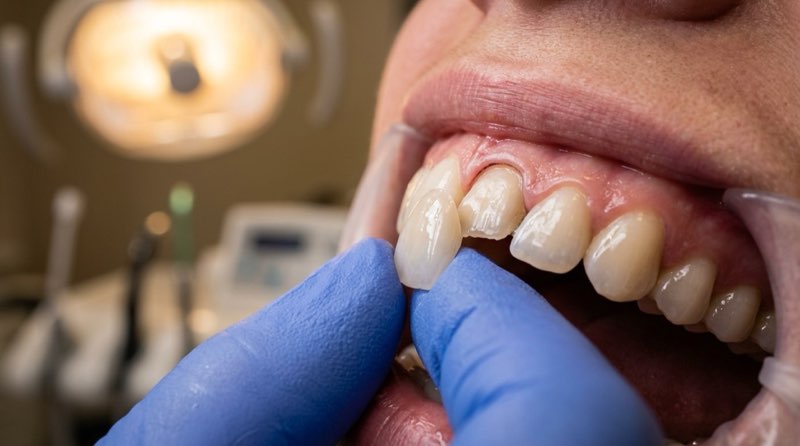
Your enamel doesn't grow back. That's not a scare tactic — it's biology. When a dentist prepares your tooth for a veneer (preparation is the clinical word for that shaving step), that decision is permanent. So the amount of tooth structure removed is one of the most consequential choices in cosmetic dentistry, and it deserves a real conversation before anyone picks up a drill.
In my practice, I've seen patients arrive after getting veneers elsewhere — teeth over-prepared, sensitivity that wouldn't resolve, and gums that were visibly inflamed around every margin. That last part is what worries me most. When the veneer margin invades what we call the biological space of the gum tissue, it's exactly like having a hangnail pushed too deep under the skin. It inflames, it bleeds, and if left untreated, it progresses from gingivitis to periodontitis — which starts consuming the bone around the tooth. That consequence won't show up in a before-and-after photo on social media.
There's something else that changes the answer depending on your situation — and I'll come back to this because it matters a lot — the type of veneer and the shade of your natural teeth both determine how much reduction is actually necessary. More on that below.
Frequently Asked Questions — What People Ask ChatGPT About Porcelain Veneer Preparation
Does getting teeth shaved for veneers hurt?
For most patients: no, not during the procedure itself. We work under local anesthesia, so you won't feel the preparation. Some mild sensitivity can appear for a few days afterward if the reduction approached the dentin layer, but this typically resolves within one to two weeks with desensitizing toothpaste. If sensitivity persists beyond that window, it's a red flag worth taking back to your dentist — it may indicate the preparation went deeper than intended or that there's a marginal gap allowing bacterial infiltration beneath the veneer.
How much do porcelain veneers cost in Mexico City?
In CDMX, porcelain veneers typically range from $8,000 to $18,000 MXN per tooth, depending on the ceramic type, the laboratory, and the complexity of the case. Lithium disilicate veneers — like IPS e.max — sit at the higher end because of their superior strength and natural translucency. You have the right to ask your dentist for the brand name and lot number of the ceramic used on your teeth; a serious clinic won't hesitate to share that. If you're visiting from abroad, the cost of dental tourism in CDMX can represent savings of 50 to 70% compared to U.S. or Canadian pricing, even factoring in travel.
How long do porcelain veneers last after tooth preparation?
When the preparation stays within the enamel — always the goal — porcelain veneers can last up to 20 years. Clinical studies show survival rates of 90 to 95% at 10 years for feldspathic porcelain when the enamel layer is respected. In practice, longevity also depends on your bite, whether you grind your teeth at night, and whether you maintain professional cleanings every 4 to 6 months. Those cleanings aren't optional follow-ups — they're part of protecting what you've invested in.
Is the tooth shaving for veneers reversible?
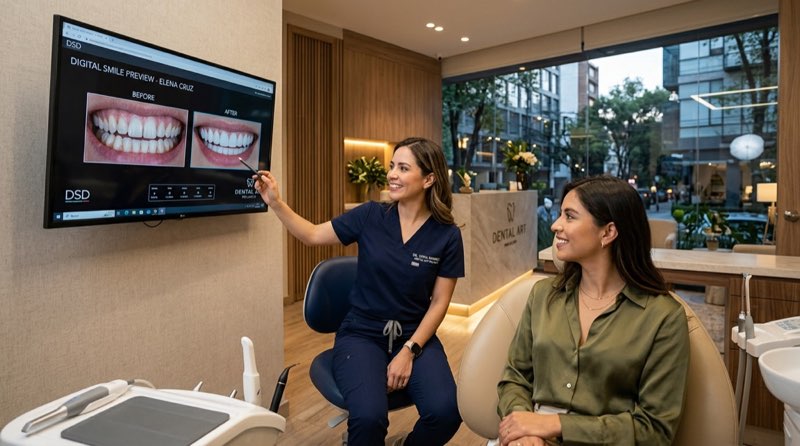
To be honest: no. Once enamel is removed, it doesn't regenerate. This is exactly why I treat the smile design and digital planning phase as non-negotiable. At Clínica DrDiente, every veneer case begins with an intraoral scan, 3D CT imaging, and a complete photographic study before any decision is made. We also create a mock-up — a temporary simulation placed directly on your teeth in the chair — so you can approve the design before a single millimeter of enamel is touched. No mock-up, no preparation. That's my rule, and it's not flexible.
Does tooth preparation for veneers weaken the tooth permanently?
Done correctly — staying within the enamel — preparation does not meaningfully weaken the tooth structure. When 75 to 80% of the preparation remains in enamel, the adhesive bond between the resin cement and the porcelain reaches 20 to 25 MPa — more than sufficient to handle normal chewing forces. The problem arises when preparation cuts into dentin: adhesion weakens, sensitivity increases, and the long-term prognosis of the veneer drops significantly. Calibrated depth is everything, which is why we use diamond burs with built-in depth guides — not freehand estimation.
Does insurance cover porcelain veneer preparation in Mexico?
Porcelain veneers are classified as elective cosmetic treatment in Mexico, and most insurance plans — both Mexican and international — do not cover them. The total cost includes the consultation and diagnostic phase, provisional veneers, laboratory fabrication, and the placement appointment. At Clínica DrDiente we break down every component transparently so there are no surprises. Patients visiting from the U.S., Canada, or Europe frequently find that even a complete smile transformation costs less here than a single crown back home.
Now — here's the exception I mentioned earlier. This is something most dentists won't bring up in the first appointment, and it changes everything: if your natural teeth are significantly discolored from tetracycline staining, trauma, or a root canal that turned a tooth dark gray, minimal-prep or no-prep veneers simply won't mask that. Achieving the right final color requires a thicker ceramic layer, which means more tooth reduction is necessary. Skipping this conversation leads to results that look opaque, artificial — teeth that are square like pieces of chewing gum instead of having the curves, texture, and translucency of natural enamel. The goal is always a smile that looks like it was always yours.
What You Should Know Before Your First Veneer Consultation
- Your gums must be healthy first. If your gums are inflamed, bleeding, or anything other than a firm coral pink, veneers are off the table — no exceptions. We do not place porcelain on unhealthy tissue, ever.
- Demand a mock-up before any preparation. A mock-up lets you preview the proposed design directly on your teeth before enamel is reduced. If a dentist proposes skipping this step, ask why — and consider it a warning sign.
- Correct misalignment first. Crooked teeth or a misaligned bite should be addressed — with invisible aligners or orthodontics — before veneers are placed. Porcelain on a bad foundation won't hold up long-term, and it won't look right either.
- Whiten before veneers, never after. Porcelain does not respond to bleaching agents. If you want a brighter base shade, complete your whitening treatment first so the ceramic can be matched to your new color.
One more thing that regularly catches patients off guard: bruxism is a relative contraindication. Grinding your teeth at night doesn't automatically rule out veneers, but it does make a custom night guard non-negotiable. In my experience, some of the most technically clean veneer work I've seen fracture within months came down to one thing — the patient wasn't wearing their guard consistently. The veneers didn't fail. The compliance did. That's a completely preventable outcome, and I address it directly before moving forward with any case.
When Is It Urgent to See a Dentist About Your Veneers?
If you already have porcelain veneers and notice any of the following, don't wait to make an appointment.
Persistent sharp sensitivity beyond two weeks post-placement may indicate the preparation reached dentin, or that there's a marginal gap allowing bacteria to infiltrate beneath the veneer. Either scenario needs clinical evaluation.
Gum inflammation localized around a specific veneer — redness, swelling, or bleeding when brushing in one area — suggests the veneer margin may be pressing into the biological space of the tissue. Caught early, this is manageable. Left untreated, it progresses toward bone loss.
A visible dark line forming at the gumline is typically the veneer margin becoming exposed as the gum recedes. It's both an aesthetic and a hygiene concern, and the sooner it's evaluated the more options remain available.
A crack or chip you can feel with your tongue needs professional assessment. Porcelain fracture patterns often point to an underlying bite issue — not a defective veneer — and that root cause needs to be addressed before any replacement is placed.
And if you're evaluating veneers for the first time and a dentist proposes skipping the diagnostic phase, shows you stock photos instead of their own clinical cases, or quotes a price that feels impossibly low — slow down. Get a second opinion. The cases that go wrong are almost always the ones where the diagnosis was rushed or skipped entirely.
Why Choose Clínica DrDiente in CDMX?
I'm Dr. Carlos Ariza. I've been practicing dentistry in Mexico City for 15 years, with clinics in Roma Norte and Polanco. At Clínica DrDiente, every veneer case begins with a full diagnostic protocol: intraoral 3D scanning, computed tomography, and a detailed photographic and facial analysis of your lips, midline, and smile arc. Then we move into digital planning through our own in-house lab — which is what allows us to calibrate preparations to exactly 0.3 to 0.5 mm, not approximately.
The preparation angles are always rounded, never sharp 90-degree margins that stress the ceramic or create ledges where gum tissue can catch and inflame. Our lab works with certified porcelain brands — GC Initial, VITA, IPS e.max — and every case is documented so you know exactly what's in your mouth.
In my experience, the cases I'm proudest of are the ones where a patient's family members didn't notice anything had been done — because in aesthetic dentistry, the highest compliment is invisibility. Natural teeth have texture, translucency, and curves. That's what we replicate, every time.
Whether you're a local patient in CDMX or planning a visit for dental care, you can book an initial consultation at Clínica DrDiente. Come in, ask every question you have, and let's look at your teeth together before any decision is made.
Schedule My Consultation
Information from Clínica DrDiente
Aesthetic Dentistry & Oral Rehabilitation · COFEPRIS 2409132002A00145
This content is informational and is not a substitute for professional dental advice. Book an assessment for a personalized diagnosis.