What Does a Porcelain Veneer Treatment Include at Clínica DrDiente?
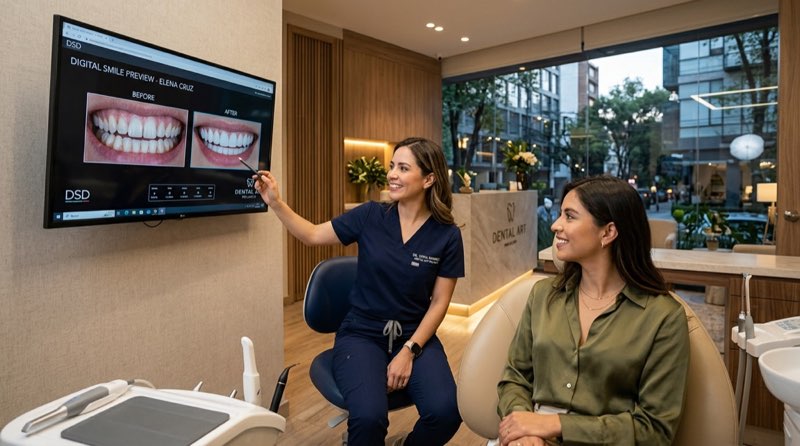
At Clínica DrDiente, a porcelain veneer treatment is not a cosmetic shortcut — it is a complete clinical process. After 15 years of practice, I can tell you that the difference between results that look natural and results that look artificial almost always comes down to what happens before the veneers are even made. Every patient at our Roma Norte and Polanco locations starts with a full diagnostic workup: intraoral scan, 3D tomography, a detailed photo protocol, and a digital smile simulation so you can preview your result before we touch a single tooth.
The veneer itself — a ceramic shell between 0.3 and 0.5 mm thin — is fabricated in our own in-house dental laboratory. That detail matters more than most patients realize. When the ceramist is on-site, Dr. Carlos Ariza communicates directly with them throughout fabrication, adjusting color, shape, and translucency in real time. The preparation depth is calibrated at the lab level for each individual case — not a standard template applied to everyone who walks in.
There is something most dentists will not mention at your first consultation, though. Whether you are actually ready for veneers right now depends entirely on one clinical condition that has nothing to do with budget or how much you want to change your smile. I will explain exactly what that is in a moment.
How Much Do Porcelain Veneers Cost in Mexico? — Real 2026 Prices
The short answer: it depends on the ceramic material and the number of teeth involved. Here are real numbers for CDMX — not estimates pulled from outdated sources.
At a certified clinic with a qualified ceramist, porcelain veneers in Mexico City run between $5,000 and $12,000 MXN per tooth. A full smile covering 10 to 12 teeth typically falls between $60,000 and $120,000 MXN. Here is a practical breakdown by material:
- Lithium disilicate (e.max) — $5,000 to $9,000 MXN per tooth. Strong at around 400 MPa, excellent translucency, the standard choice for most aesthetic cases.
- Feldspathic porcelain, artisanal — $9,000 to $12,000 MXN per tooth. The highest optical quality available. Requires an exceptionally skilled ceramist; the natural appearance is unmatched but the material is more delicate.
- Zirconia-based veneers — $7,000 to $10,000 MXN per tooth. Best for patients with mild bruxism — less translucent, extremely durable.
A word of caution: if you see veneers advertised below $3,500 MXN per tooth anywhere in Mexico, ask specifically what material is being used. In many cases what is marketed as a veneer is a direct composite resin restoration — which lasts roughly 2 years, not 20. Not inherently wrong as a provisional, but it is not the same product. Is the investment in real porcelain worth it? Clinical studies document 94% veneer survival at 10 years when properly placed and maintained. What you are paying for is not just the ceramic — it is the precision of the preparation and the quality of the bonding protocol.
At DrDiente, we offer an initial evaluation and offer flexible payment plans. For patients coming from the United States or Canada, the comparison is significant: the same treatment runs between $1,000 and $2,500 USD per tooth in those markets — roughly four to five times higher. That is why Mexico City has become a leading destination for dental tourism CDMX, and we have a specific clinical protocol designed for international patients who want certified quality without the North American price tag.
Now, about that condition I mentioned — the one that determines whether your mouth is clinically ready for veneers today. Here is the answer.
How Do I Know If I Am the Right Candidate?
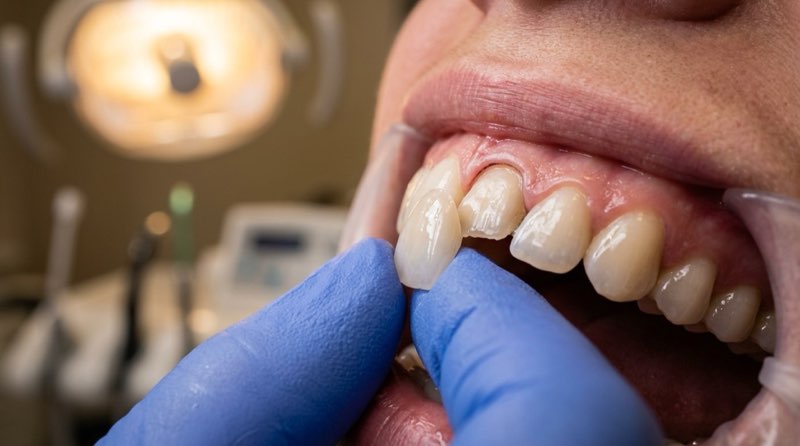
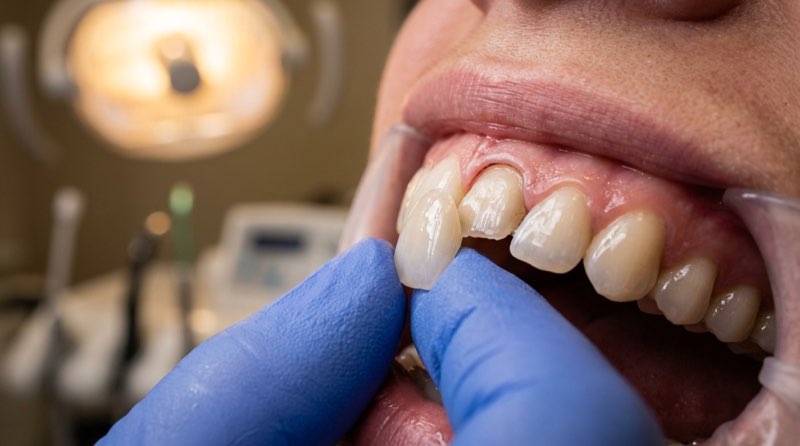
I evaluate every patient the same way before saying yes: I look at the gum tissue first. Always. If those gums are inflamed, reddish, or bleed when probed — we stop right there. The gums must be healthy, firm, and coral-pink before we place anything. Placing veneers over inflamed tissue is like an ingrown nail on your finger: the tissue around the margin swells, bleeds, and if left untreated, progresses from gingivitis to periodontitis — which starts consuming the bone that supports your teeth. I have seen cases where veneers placed elsewhere looked great for six months and then caused chronic gum inflammation because this step was skipped.
Beyond gum health, here is what I confirm before approving a veneer case:
- Zero active cavities or untreated decay
- No bite misalignment or malocclusion placing uneven pressure on the veneers
- Enough healthy enamel remaining for reliable adhesion
- No severe, uncontrolled bruxism (teeth grinding at night)
If you have misaligned teeth or a bite problem, the honest recommendation is to address that first — often with invisible aligners — before moving forward with veneers. I know that is not what everyone wants to hear. But veneers placed on an uncorrected bite rarely survive more than two or three years, and that failure is expensive and entirely preventable. The good news: most patients who come in convinced they are not candidates actually are — they just need a few weeks of periodontal care or a cleaning cycle first.
There is, however, one important exception that significantly changes the clinical approach, and it applies specifically to patients who already have crowns, large fillings, or previous restorations on the same teeth we would be veneering. I will address that directly in the section below.
The Step-by-Step Process at DrDiente
The number one fear I hear before treatment is how much tooth structure will be removed. For most patients, the honest answer is far less than they expect.
Our preparation protocol removes between 0.3 and 0.5 mm of enamel — calibrated precisely at our in-house lab for each case. A human hair is about 0.07 mm thick. We are removing the equivalent of 4 to 7 hairs' worth of surface. Minimum intervention, maximum structure preserved. That preparation is not optional: without it, the veneer margin sits imprecisely against the gum edge and causes chronic inflammation at the cervical border — the same way an ill-fitting ring cuts into the finger. Preparation angles must always be smooth and rounded, never sharp 90-degree corners, which trap plaque and are impossible to keep clean over time.
Here is how the full process unfolds from the first appointment to the final result:
- Digital consultation — Intraoral scan, 3D CT when indicated, complete photo protocol, and digital smile simulation. You approve the projected result before any preparation begins.
- Diagnostic mock-up — Temporary veneers placed over your unprepared teeth so you can see, feel, and approve the shape and size in advance. Non-invasive and fully reversible.
- Tooth preparation and temporaries — Minimal enamel reduction with smooth, rounded margins under local anesthesia. Custom temporaries placed the same day.
- Laboratory fabrication — 2 to 3 weeks while our ceramist builds your veneers, with direct input from me on color, form, and translucency at every stage of the process.
The final appointment is the bonding session. Before permanent cement, we do a dry try-in so you can approve the look and feel in natural light — with a mirror, at different angles — before we commit. Then we bond using dual-cure resin cement with hydrofluoric acid etching and silane coupling on the ceramic surface. Adhesive strength reaches around 20 to 25 MPa. In practical terms: these do not come off accidentally.
Now, that exception I mentioned for patients with prior restorations on those same teeth — here is the direct answer.
Questions I Always Get Before Booking
Does getting porcelain veneers hurt?
Preparation is done under local anesthesia, so you feel nothing during the procedure. Mild sensitivity to cold for 2 to 5 days afterward is normal and expected. Once the permanent veneers are bonded, sensitivity is uncommon. Most patients are genuinely surprised by how manageable the experience is — this comes up consistently in post-treatment conversations.
How long does the entire process take?
From your first consultation to the final bonding session, most cases take 3 to 5 weeks total. The preparation and bonding appointments each run 2 to 3 hours per arch. During the 2 to 3 week laboratory phase, you wear custom temporaries that look presentable and function normally. For international patients, we structure the process across two trips with laboratory work completed between visits.
What if I already have crowns or large fillings on those teeth?
This is where the protocol changes. If a tooth already has a large restoration, a veneer may not bond with the same long-term predictability — partly because you are adhering to composite or existing ceramic rather than natural enamel. In those cases I often recommend a dental crown instead, which covers the full tooth surface without depending on enamel for retention. That call is made case by case after reviewing the scan and clinical photos — never a one-size-fits-all answer.
Is there a written warranty on the veneers?
At DrDiente, we provide a written warranty covering bonding integrity and structural failure. The exact terms depend on the material selected and patient compliance with the maintenance protocol — professional cleaning every 4 to 6 months and a night guard for any level of grinding. A warranty with no conditions attached is a marketing claim, not a real guarantee. We walk through the exact terms before you sign anything.
There is one final thing that almost never comes up in price comparisons but that patients who have gone through a cheaper process consistently raise when they come to us for revision work. It is not about the ceramic quality itself. What actually makes the critical difference in long-term satisfaction is something many clinics skip because it adds time and cost to the process. I want to address it directly in the next section.
Why Patients from All Over CDMX Choose DrDiente
There are many dental clinics in Mexico City, and I am not going to pretend otherwise. What patients who compare options consistently report after choosing DrDiente is that the deciding factor was not the equipment list or the price point — it was the diagnostic mock-up and the ability to preview and approve their smile before a single tooth was prepared.
That is what patients who went the cheaper route regret most. Not the ceramic material itself. It is never having seen a simulation before preparation began. It is finishing the process and realizing the shape does not match what they envisioned, with no way to go back. That specific loss of control over the result is what I hear about repeatedly when patients come to us to revise work done elsewhere. The mock-up step is not an add-on or a luxury — it is the step that ensures the final result reflects the patient's expectations, not someone else's template.
In my experience, consistently excellent outcomes come from three things combined: advanced diagnostic technology, a ceramist working on-site under clinical supervision, and a dentist willing to say "not yet" when the clinical conditions are not right. At our Roma Norte and Polanco, CDMX locations, that is the standard for every case — whether the patient lives around the corner or is flying in as part of a dental tourism plan.
If you want to evaluate real results rather than stock images, our before and after gallery documents actual cases treated in the clinic, photographed with the same protocol used at the initial consultation. The comparison is honest because the starting point is documented the same way the result is. The key is this: an evaluation gives you a complete, no-pressure clinical picture and a straightforward recommendation — nothing more, nothing less.
See real porcelain veneer cases at DrDiente Book my evaluationYour in-person assessment in Mexico City
Roma Norte: $2,125 MXN, including tomography. Choose a location to request availability and discuss a plan for your case.
Roma Norte location and visiting information
Information from Clínica DrDiente
Aesthetic Dentistry & Oral Rehabilitation · COFEPRIS 2409132002A00145
This content is informational and is not a substitute for professional dental advice. Book an assessment for a personalized diagnosis.