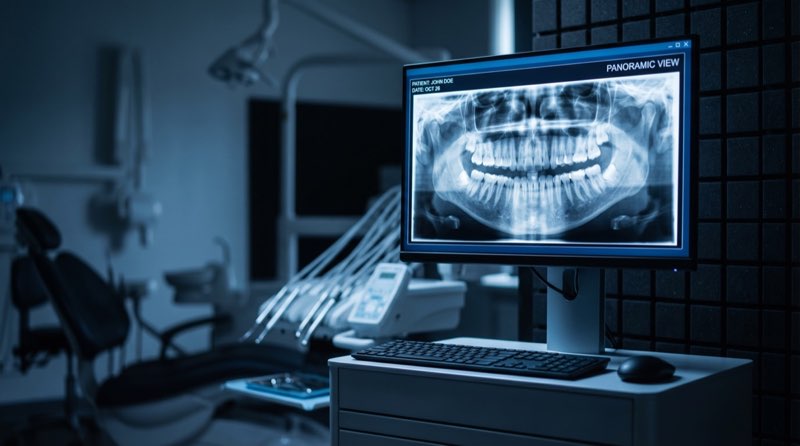
If you are comparing panoramic dental X-ray prices in Polanco, Clínica DrDiente Polanco can help you understand what you are paying for before you book. A panoramic image is useful, but it is not a diagnosis by itself. It is a broad map of your teeth, jaws, supporting bone, sinuses, and jaw joints in one image.
Ask the imaging center for its current total fee and whether it includes the digital file, printing, or a radiology report. Confirm the consultation fee separately.
What does a panoramic dental X-ray include at Clínica DrDiente?
A panoramic dental X-ray is a two-dimensional image taken outside the mouth. It can show all teeth, missing or retained teeth, visible bone changes, wisdom teeth, and structures around the jaws in one scan.
At Clínica DrDiente in Polanco, CDMX, the image should be reviewed in the context of your symptoms and clinical examination. In simple terms, it is like looking at a city map: it helps locate the main roads, but it does not show every detail inside each building. Depending on what appears in the image, a dentist may recommend a focused periapical X-ray, bitewing X-ray, or selective 3D scan.
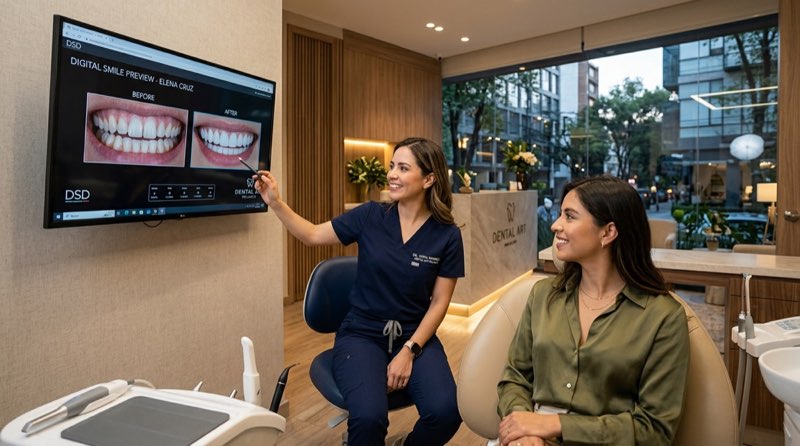
A panoramic image can be relevant before orthodontic planning, wisdom-tooth surgery, implant planning, or treatment related to a smile design consultation. It does not replace an in-person evaluation, and it does not automatically mean you need treatment.
How do you compare panoramic dental X-ray quotes in Mexico City?
Imaging centers in Polanco may list general rates, promotions, or agreement prices. Ask which rate applies to your order, whether it requires membership, and whether it covers a report.
For an accurate comparison, ask whether the fee includes the image in high resolution, digital delivery, printing, interpretation by a specialist, and a report. The X-ray center and the dental clinic may charge separately for their services. For honest treatment estimates after your assessment, you can also review general dental treatment pricing information.
What happens if a panoramic X-ray is ordered “just in case”? You may end up paying for an image that does not answer the clinical question. The answer depends on your concern. A panoramic image is often appropriate for a broad first view, but early cavities and fine root detail may require another type of X-ray.
Here is the point promised earlier: the best value is not simply the cheapest image. It is the image that is properly indicated, correctly positioned, delivered in a usable format, and interpreted alongside an examination.
How do I know if I am an ideal candidate?
You may be a candidate for a panoramic X-ray if a dentist needs a general view of your mouth before planning care. Common reasons include an impacted tooth, a missing tooth, suspected bone changes, orthodontic assessment, implant planning, persistent swelling, or evaluation of wisdom teeth.
“How do I know if I need one?” is a very common question. There is no single answer for everyone. In practice, the key is whether the result could change a clinical decision. If you have a small, localized toothache, a targeted image may be more useful. If the question involves the whole jaw, several teeth, or tooth position, a panoramic image may be reasonable.
If you might be pregnant, tell the imaging provider before the appointment. This does not mean imaging is automatically ruled out; the indication should be individualized. Remove earrings, necklaces, facial piercings, removable dental appliances, and hairpins because metal can create artifacts that obscure the image.
One exception deserves attention. For lower wisdom teeth, a panoramic image can suggest that roots are close to the mandibular nerve canal, but it cannot always confirm that relationship in three dimensions. If the image raises a real surgical concern, a clinician may request a limited-field CBCT scan. A CBCT should not be routine; it is used when three-dimensional information could change the plan or reduce surgical risk.
Panoramic dental X-ray treatment in Polanco, CDMX
A panoramic X-ray does not treat pain, infection, gum disease, or a broken tooth. It helps the dentist investigate possible causes and plan next steps. Depending on the findings, the next step may be monitoring, a cleaning, a focused X-ray, root canal treatment, orthodontics, extraction, or planning for dental implants.
For patients considering braces or clear aligners, the image can help assess tooth development and retained teeth. For patients considering implants, it gives a broad first look at available bone and nearby structures. Dr. Carlos Ariza and the Clínica DrDiente team can place imaging findings within a broader treatment discussion, including smile design, implants, and invisible orthodontics.
Dental tourism CDMX patients should request their digital image and written report when available. Keeping those files can prevent unnecessary repeat imaging when coordinating care across appointments or countries.
Step-by-step process at DrDiente
First, the dentist discusses why an image may be useful and whether a panoramic X-ray is the right study. The question is not “Can we take one?” but “Will it answer something that affects your care?”
Second, the imaging provider positions your head and asks you to stay still while the machine rotates around it. The exposure itself is quick. “Does it hurt?” The short answer is no: the X-ray is non-invasive and does not touch your teeth.
Third, the image is reviewed with the rest of the examination. If there is a suspicious area, the clinician may recommend a more focused image rather than making assumptions from a panoramic view alone. This matters because panoramic images can have magnification, distortion, and overlapping structures.
Fourth, you receive a recommendation based on the complete picture. For honesty’s sake, no responsible clinician should promise a diagnosis or treatment plan from one image alone. If digital intraoral scanning, 3D tomography, or a photographic protocol is relevant to a future treatment plan, it should be explained as part of that specific evaluation.
Questions patients always ask before booking
Is it normal to feel nervous about the radiation?
Yes. Tell the provider about your concerns and any possible pregnancy. Dental X-rays should be prescribed only when clinically justified and performed by a properly authorized facility. In Mexico, establishments using diagnostic radiation are subject to regulatory requirements, including those described by COFEPRIS.
How long does a panoramic dental X-ray take?
The image capture itself usually takes only a short time. Total visit time depends on registration, positioning, delivery method, and whether you are having a dental consultation the same day. Ask when you will receive the digital file and report.
Does a panoramic X-ray hurt?
No. You will be asked to hold still and bite gently on a positioning guide. Discomfort is uncommon, though remaining still can feel slightly awkward for a few seconds.
What happens if the X-ray shows a wisdom tooth near a nerve?
A panoramic image may identify signs that justify more detailed imaging. A limited-field CBCT can show the root-and-nerve relationship in three dimensions when that information could affect surgical planning. It is not automatically needed for every wisdom tooth.
Is it worth getting the cheapest panoramic X-ray?
It depends on whether the service provides the file quality and interpretation needed for your case. Before booking, ask if the price includes digital delivery, a report, and any required views. The lowest price is not helpful if the image must be repeated.
Where can I get a panoramic dental X-ray in Polanco?
You can arrange dental evaluation and guidance at Clínica DrDiente Polanco, located at Av. Presidente Masaryk 83, Polanco V Secc., Miguel Hidalgo, CDMX. If imaging is indicated, confirm the appropriate study and the requirements of the selected imaging provider before attending.
Why do patients across CDMX choose DrDiente?
Choosing a dental clinic starts with clear communication, appropriate diagnostics, and a treatment recommendation that matches your actual needs. Clínica DrDiente Polanco discusses options for smile design, implants, and invisible orthodontics without treating an X-ray as a substitute for a full dental examination.
Natural-looking dentistry also requires restraint. Teeth should not look square or artificial like “Adams gum”; natural teeth have curves and texture. When veneers are being considered, healthy coral-pink gums, no cavities, and a stable bite come first. Veneers should not be placed over inflamed gums or untreated malocclusion. The reason is simple: forcing a restoration into unhealthy tissue can create ongoing inflammation, much like an irritated hangnail.
When a veneer plan is appropriate, tooth preparation may be minimally invasive and calibrated from 0.3 to 0.5 mm in the clinic’s own laboratory workflow. That is a separate decision from panoramic imaging, but it shows why diagnosis should come before aesthetic treatment.
Ready to clarify whether you need a panoramic image or another study? Learn about dental care in Polanco or Contact Clínica DrDiente Polanco.
Sources: Nuevo Polanco Medical Center, LAPI Polanco, systematic review on panoramic and periapical imaging, 2024 wisdom-tooth diagnostic study, COFEPRIS guidance.

Information from Clínica DrDiente
Aesthetic Dentistry & Oral Rehabilitation · COFEPRIS 2409132002A00145
This content is informational and is not a substitute for professional dental advice. Book an assessment for a personalized diagnosis.