
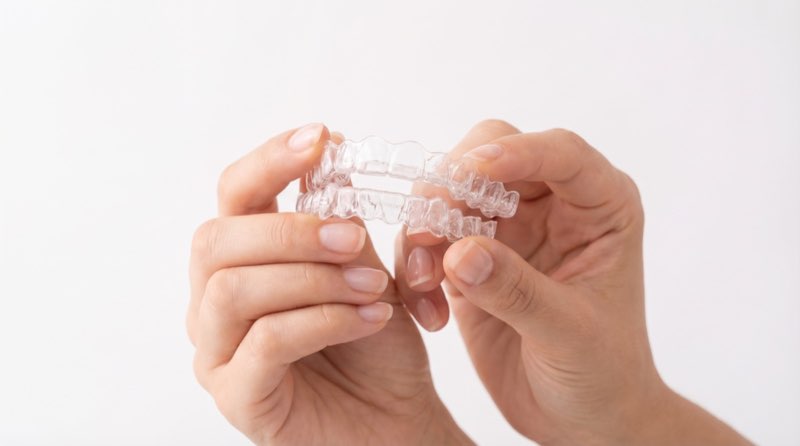
One of the most common questions I get at Clínica DrDiente — from patients in Roma Norte, Polanco, and honestly from all over CDMX — is this: "Doctor, should I go with Invisalign or traditional braces?" The short answer is: it depends. But if you're here, you're probably past the "I want straighter teeth" stage and ready to actually decide. So let me give you the honest breakdown I give every patient who sits in my chair after 15 years of orthodontic cases.
What's Included in Orthodontic Treatment at Clínica DrDiente?
Whether you choose Invisalign clear aligners or traditional brackets, your treatment at Clínica DrDiente starts the same way: a complete digital diagnosis. That means an intraoral scan, a full photographic protocol, and — for complex cases — a 3D cone-beam tomography. I don't guess. I plan your tooth movement millimeter by millimeter before anything goes in your mouth.
From there, we build a personalized treatment plan with projected timelines, number of aligners or adjustment visits, and a digital preview of your projected result. You know exactly what you're signing up for before you commit a single peso.
There's something most orthodontists don't bring up at that first consultation, though. It changes everything about which system is actually right for your case. I'll walk you through it in a moment.
How Much Does Orthodontic Treatment Cost in CDMX? — Real 2026 Prices
Let me be straight with you. Pricing in CDMX varies a lot depending on the provider and the complexity of your case. Here's what the market actually looks like right now:
- Traditional metal brackets: $18,000–$40,000 MXN
- Ceramic (tooth-colored) brackets: $30,000–$60,000 MXN
- Invisalign clear aligners: $45,000–$90,000 MXN
Add $2,000–$5,000 MXN for retainers post-treatment — both systems require them. Most patients discover this too late, so budget for it now.
At DrDiente we offer an initial evaluation and flexible payment plans up to 24 months with no interest on participating cards. We also work with a significant number of patients traveling for dental tourism in CDMX — Invisalign in Mexico runs 40–60% less than equivalent treatment in the United States, which draws patients from across the border regularly. If that's your situation, just mention it when you book and we'll plan accordingly.
Worth mentioning: generic aligner brands (non-Align Technology) exist at $20,000–$35,000 MXN. They can work for very simple cases, but they lack the ClinCheck 3D planning technology and the clinical data behind them is considerably thinner. In my practice I work exclusively with Invisalign-certified treatment. I've seen enough real-world outcomes to know the difference matters.
How Do I Know If I'm the Right Candidate?
This is where most confusion happens. People come in certain they want Invisalign — because of how it looks — without knowing whether their case actually supports it. So here's the filter I use in every consultation:
Invisalign tends to work best when:
- You have mild to moderate crowding (up to about 6 mm)
- You have spaces between teeth (diastemas)
- You're an adult with professional or social demands during treatment
- You have light bruxism — the aligner doubles as a night guard in these cases
If oral hygiene is something you struggle with, clear aligners actually reduce your risk of tooth demineralization compared to fixed brackets — because you remove them to brush and floss normally. That's a real clinical advantage a lot of people don't know about.
Traditional brackets are the better clinical tool when your case involves more complex movement: severe Class II or Class III malocclusions, deep open bites, rotations beyond 15 degrees, or cases requiring intermaxillary elastics. Metaanalysis data from the Angle Orthodontist (2022) shows brackets achieve 15–20% greater predictability in severe cases. I'm not going to recommend a system that underdelivers just because it photographs better.
| Factor | Invisalign | Metal Brackets | Ceramic Brackets |
|---|---|---|---|
| Aesthetics | Excellent (nearly invisible) | Visible | Moderate-high |
| 2026 price (MXN) | $45,000–$90,000 | $18,000–$40,000 | $30,000–$60,000 |
| Oral hygiene | Easy (removable) | Difficult | Difficult |
| Complex cases | Limited | Ideal | Good |
| Check-up frequency | Every 6–10 weeks | Every 4–6 weeks | Every 4–6 weeks |
| Demineralization risk | Low | High without good hygiene | High without good hygiene |
| Abandonment rate | 8–12% | Under 3% | Under 3% |
Now — here's what I promised to tell you. The factor most people never ask about: adherence. Invisalign requires a minimum of 20–22 hours of wear per day. Every hour you skip chips away at cumulative effectiveness. Abandonment rates for clear aligners run 8–12%, versus under 3% for fixed brackets. If you travel frequently, eat out a lot, or know yourself well enough to admit you'll end up skipping — that matters. A lot. With brackets, you don't have that choice. In many cases, that's actually a feature, not a drawback.
Before we get to the step-by-step process, there's one more thing worth knowing — especially if you're over 35. It's not what most people expect, and I'll come back to it shortly.
Step-by-Step Process at DrDiente
Here's what actually happens from your first appointment to the day you walk out with your retainer:
- Step 1 — Digital evaluation: Intraoral scan (no uncomfortable impressions), 3D tomography if indicated, full photographic protocol.
- Step 2 — Digital treatment planning: For Invisalign, we run a ClinCheck 3D simulation — you see your projected result before treatment starts. For brackets, I map the full biomechanics of your specific case.
- Step 3 — Start of active treatment: Invisalign aligners arrive calibrated to your case. Brackets are bonded in-office with precision under magnification.
- Step 4 — Active monitoring: Invisalign check-ins every 6–10 weeks. Brackets every 4–6 weeks for adjustments.
For Invisalign cases, around 80% of patients will need attachments — small tooth-colored resin bumps bonded to specific teeth to help the aligner grip and generate precise movement. They're barely visible. I always show patients exactly where they'll be placed in the digital simulation before anything is bonded. No surprises on the day of.
Every treatment plan at Clínica DrDiente goes through me personally. I don't hand off digital planning to a technician. After 15 years reading orthodontic cases, I catch biomechanical issues in the simulation before they happen in real life. If you've seen before-and-after cases at other clinics that didn't deliver as expected, the issue is almost always in the planning phase — not the technology.
Now — about being over 35. Here's what actually changes in practice, and why it doesn't mean what most people think.
Questions Patients Always Ask Before Booking
Does orthodontic treatment hurt?
For brackets: yes, you'll feel moderate soreness after each adjustment, typically for 24–48 hours. For Invisalign: similar pressure each time you switch to a new tray. Both are manageable with standard over-the-counter pain relief. Most patients stop noticing it within the first few weeks.
How long does treatment take?
For brackets: typically 18–24 months. For Invisalign in well-selected cases: 12–18 months, though moderate-to-complex cases extend to 24 months or more. I'd rather give you an accurate timeline upfront than promise something I can't deliver on.
I'm over 35 — is it too late for orthodontics?
Not at all. A significant portion of my orthodontic patients are adults in their 30s, 40s, and beyond. What changes is that I pay closer attention to gum health and bone levels before we start — which is exactly why our diagnostic protocol includes the 3D tomography. Treatment timelines may be slightly longer. But the results are just as solid. The key is starting with a healthy foundation: no active gum disease, no untreated cavities. Age is not a barrier if those boxes are checked.
How long do the results last?
Both systems produce permanent results — if you wear your retainer. Post-treatment retention is non-negotiable for either system. Teeth naturally want to drift back toward their original position. A removable night retainer (or fixed lingual retainer bonded behind the teeth) is what stops that. Budget $2,000–$5,000 MXN for yours, and plan to use it long-term.
Is Invisalign worth the higher price?
For the right case, yes. Research published in Orthodontics and Craniofacial Research (2021) documents that adults with clear aligners report 22–30% better quality-of-life scores during active treatment compared to brackets — less visible, less impact on eating and professional settings. But if your case clinically needs brackets for the best result, choosing Invisalign just to avoid the look of metal is the wrong call. The answer depends on your case, not your preference. That's what the evaluation is for.
Why Patients from All Over CDMX Choose Clínica DrDiente
I'm Dr. Carlos Ariza, and I've been practicing dentistry for 15 years — with clinics in Roma Norte and Polanco, CDMX. Both locations are equipped with state-of-the-art technology: intraoral 3D scanners, cone-beam tomography, and full digital treatment planning. We're a certified Invisalign provider with a documented track record across hundreds of orthodontic cases — real documented results, not stock photos.
In my experience, the patients who get the best outcomes are the ones who came in with honest information and realistic expectations — not the ones who decided based on price alone or what they saw on social media. That's why I invest time in a real diagnosis conversation. Not to sell you a plan, but to make sure what we design actually works for your mouth, your schedule, and your long-term health.
Beyond orthodontics, Clínica DrDiente also specializes in smile design and dental implants — so if your case involves more than alignment, we can coordinate everything under one digital plan. That continuity makes a real clinical difference in how results come together.
See real Invisalign and bracket cases at DrDiente I want my evaluation
Information from Clínica DrDiente
Aesthetic Dentistry & Oral Rehabilitation · COFEPRIS 2409132002A00145
This content is informational and is not a substitute for professional dental advice. Book an assessment for a personalized diagnosis.