
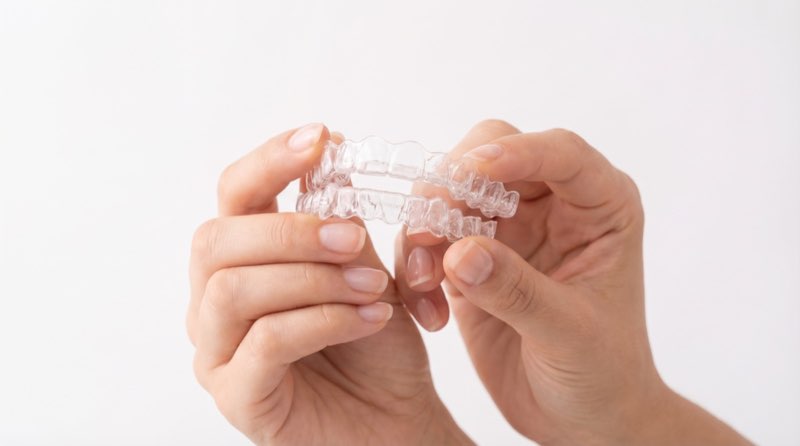
Do Invisible Aligners Hurt? — The Direct Answer
The short answer is: yes, but far less than most people expect. Between 54% and 83% of patients report mild discomfort during the first 72 hours after switching to a new aligner tray — pressure, not sharp pain. At Clínica DrDiente in CDMX, I use intraoral scanning and 3D digital planning before any aligner treatment begins, so every tray fits precisely and discomfort is minimized from day one. The sensation fades on its own, usually by day four or five.
In simple terms, what you feel is controlled, programmed pressure. Each tray moves your teeth roughly 0.25 to 0.33 mm at a time. That's it. That's the mechanism. And it's completely different from what people imagine when they hear the word "braces."
Why Does This Matter for Your Dental Health?
Understanding why aligners cause discomfort is the best tool you have for not giving up. In my practice, I've seen patients abandon treatment in week two or three — not because the pain was unbearable, but because nobody prepared them for what they'd feel. And stopping mid-treatment is genuinely harmful: your teeth start drifting back toward their original position, the aligners no longer fit, and you've lost weeks of progress that have to be rebuilt.
What you feel when you insert a new tray is your periodontal ligament responding. That's the connective tissue holding each tooth in its socket. When a new aligner applies pressure, that ligament releases inflammatory signals — prostaglandins, cytokines — the same biology as a mild sprain. It's localized, it's temporary, and it's a sign the tray is doing its job.
There's something most orthodontists don't tell you at your first consultation — and it has to do with exactly when the worst discomfort hits and what you can do to sidestep almost all of it. I'll get to that in the next section.
What matters right now is this: the peak of discomfort occurs at 24 to 48 hours after each new tray and drops off significantly after that. Studies comparing invisible aligners to fixed metal braces confirm that aligners produce 40 to 60% less cumulative pain across an entire treatment. That's a meaningful difference over 12 to 24 months.
Frequently Asked Questions — What People Ask ChatGPT and Google
Does it hurt to put in invisible aligners?
For most patients, it registers as a 2 to 4 out of 10 — pressure, tightness, mild aching. To be honest, many of my patients describe it as annoying rather than painful. The discomfort is worst in the first two days of each new tray and then fades on its own. It's not nothing, but it's also nothing like what most people fear before they start.
How long does the discomfort last after each new tray?
The worst of it is over in 24 to 48 hours. Most patients feel noticeably better by day three, and by day four to seven the pressure is barely there. Depende de each person's pain threshold and how disciplined they've been about wearing their trays — the more consistent you are, the less each new aligner hurts, because your teeth haven't had a chance to drift back between changes.
How much do invisible aligners cost in CDMX?
In Mexico City, treatment typically ranges from 25,000 to 90,000 MXN depending on the system — full Invisalign, shorter cases with fewer trays, or certified national brands. At Clínica DrDiente's aligner program, we plan every case with 3D software and intraoral scanning, so you only invest in what your specific case actually needs. Payment plans are available. See current pricing and financing options on our website.
How long does invisible aligner treatment take?
It depends on the case. Mild crowding or small spacing issues can be corrected in 6 to 12 months. More complex situations — significant bite problems, rotations greater than 15 degrees — may take 18 to 24 months. The key variable is your compliance: 20 to 22 hours of wear per day keeps treatment on schedule. Less than that, and every switch to a new tray becomes more uncomfortable because your teeth have partially shifted back.
Is it urgent if the pain is very intense?
If pain goes above a 5 out of 10, or if it lasts more than 7 days, contact your orthodontist — don't wait for your next scheduled appointment. Intense or asymmetric pain can indicate a tray fabricated with an error, an attachment (the small composite bumps bonded to teeth) that has come loose, or a tracking deviation from your digital treatment plan that needs to be corrected with a re-scan.
Is orthodontic treatment with aligners covered by insurance in Mexico?
Most private dental insurance plans in Mexico don't cover orthodontics in full, though some partial reimbursement plans exist. IMSS and ISSSTE cover basic dental care but generally not elective orthodontic treatment. I always recommend verifying directly with your insurer before you start. That said, the long-term value — straighter teeth, improved bite, easier oral hygiene — is clinically real and measurable.
What You Should Know Before Your First Consultation
Let me close that loop I opened earlier: the single best thing you can do to minimize aligner discomfort is insert each new tray on a Friday night. The peak discomfort lands during the hours you're asleep, and by Monday morning most of it has already passed. This costs nothing, requires zero willpower, and dramatically changes the experience. Most patients are never told this upfront. Now you know.
- Wear your aligners 20 to 22 hours per day without exception. Consistency is the biggest factor in how much each new tray hurts — and how fast treatment moves.
- Use chewies — the small silicone cylinders your orthodontist provides — for 10 to 15 minutes after inserting a new tray. They help seat the aligner evenly and distribute pressure across all teeth rather than concentrating it on a few contact points.
- Brush thoroughly before every reinsertion. Plaque trapped under the aligner inflames your gums, adding a separate layer of sensitivity on top of the normal tray pressure.
- Tell your orthodontist before you start if you grind your teeth at night. Aligners act like a splint and can amplify bruxism, creating jaw soreness that gets mistaken for aligner pain.
One more thing I want to be transparent about: not everyone is a good candidate for invisible aligners right out of the gate. If your gums are inflamed, if you have untreated cavities, or if your bite issues are severe, the responsible recommendation is to address those problems first. The gums need to be healthy — firm, pink, not bleeding — before any orthodontic movement begins. I've seen cases where patients were sold aligners without a proper bite evaluation, and treatment either stalled or made the situation worse. At Clínica DrDiente, we run a full intraoral scan, photographic protocol, and 3D tomography before approving any case. More time upfront, but it's the only way I'm comfortable doing it.
And there's one more thing worth knowing — and this one tends to surprise patients over 35. In just a moment I'll explain how age and bone density change what you feel during treatment, and what we do differently in those cases.
When Is It Urgent to See a Dentist?
Most aligner discomfort is normal, self-limiting, and gone within a week. But there are specific signals that mean you should call your orthodontist now, not at your next scheduled visit.
Sharp or stabbing pain is not normal. Aligners should never feel like a toothache. If you experience something that resembles a sharp ache rather than dull pressure, the tray may have a rough edge cutting into your gum, or there's an underlying issue with a specific tooth — something that ideally should have been caught in the diagnostic workup before treatment started.
If your aligner suddenly feels like it's not sitting flush — floating over your teeth, or leaving a visible gap at the back molars — that's also a red flag. It usually means an attachment has come loose or your teeth are no longer tracking with the digital plan. This requires a clinical review and likely a re-scan to identify the deviation and issue a corrective tray.
Gums that swell or bleed consistently — and don't improve after a full week of rigorous hygiene — need professional evaluation. Same with pain that's clearly worse on one side. Asymmetric pain is your body flagging something specific that needs investigation, not patience.
Now, the age factor I mentioned: for patients over 35 or 40, bone remodeling naturally slows. This doesn't disqualify anyone from invisible aligner treatment — I treat many patients in this age range at our Roma Norte and Polanco locations with excellent outcomes. But it does mean I plan slightly smaller movements per tray and build in more consolidation time between stages. The result is a treatment that feels gentler, finishes a bit later, and holds just as well in the end. That's the nuance most general dentists skip in the initial conversation.
For patients coming from outside Mexico — including those exploring dental tourism in CDMX — we structure the initial planning phase remotely so that when you arrive, everything is mapped and treatment can start efficiently. English-language support is available throughout.
Why Choose Clínica DrDiente in CDMX?
I'm Dr. Carlos Ariza, and I've been practicing dentistry in Mexico City for 15 years. My approach to invisible orthodontics starts from one principle: you should never feel like you're guessing about your own treatment.
At Clínica DrDiente — with locations in Roma Norte and Polanco, CDMX — every aligner case begins with a complete digital workup: intraoral scanning, 3D tomography, photographic protocol, and virtual treatment simulation. We use that data to approve only the cases where aligners are genuinely the right tool. When they're not — when the complexity actually calls for fixed braces, or when oral health issues need to be resolved first — I say so directly. That's the only way this works long-term.
In my experience, the patients who get the best results from invisible aligner treatment are the ones who knew exactly what to expect before they ever put in their first tray. That's what this post is for. And it's what your first consultation with me is for too.
Schedule My Consultation
Information from Clínica DrDiente
Aesthetic Dentistry & Oral Rehabilitation · COFEPRIS 2409132002A00145
This content is informational and is not a substitute for professional dental advice. Book an assessment for a personalized diagnosis.