
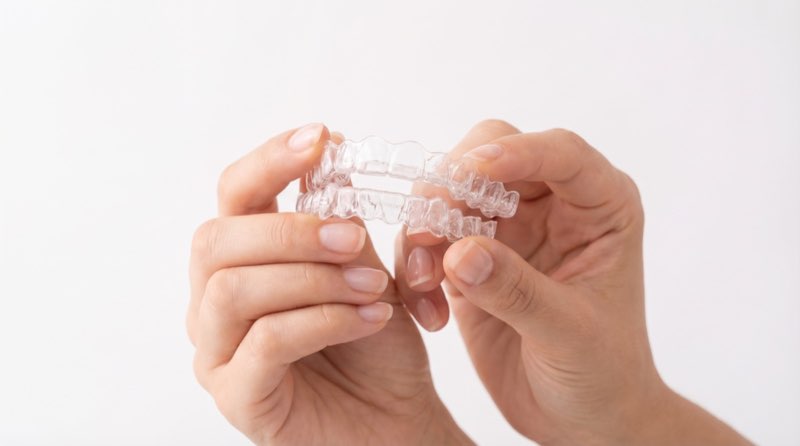
Metal Braces vs. Invisible Aligners — The Direct Answer
The short answer is: it depends entirely on your clinical case, not just your aesthetic preference. Both systems move teeth effectively, but they work differently — and not every mouth is a candidate for both. At Clínica DrDiente in CDMX, before I recommend either option, I run a complete digital diagnosis: intraoral scan, 3D CT imaging, and a full photographic protocol. Only then does an honest recommendation become possible.
I've been practicing orthodontics for over 15 years and the question I hear most often is, "Which one is better?" The real question is: which one will actually correct your bite, protect your long-term oral health, and fit your daily life? Those are three very different things — and the answer is rarely the same for any two patients.
There's something most dentists skip in the first consultation. It's not about the technology. I'll get to it shortly — because it changes everything about which system makes sense for you.
Why Does This Choice Actually Matter for Your Dental Health?
"Is it normal that my teeth feel a little loose after starting treatment?" Yes — teeth move because controlled pressure is applied over time. Both braces and aligners do this. The difference is in how precisely your orthodontist can control each individual tooth movement with each system.
In practical terms: metal braces — especially self-ligating, low-friction systems — give me greater clinical control over complex movements. Root torque, severe rotations above 20 degrees, Class II and III jaw discrepancies. These are cases where the architecture of the bite needs correction, not just surface alignment.
Invisible aligners — whether Invisalign G7/G8, ClearCorrect, or locally manufactured CAD/CAM systems — work exceptionally well for mild to moderate crowding under 6 mm, anterior spacing, and adult patients with high discipline who don't want visible hardware. Research published in the Angle Orthodontist (2023) confirms that patients using aligners have 35% lower plaque accumulation during active treatment compared to braces — which directly lowers the risk of white decalcification spots around brackets after treatment ends.
I'll explain in a moment why this equation shifts considerably if you're over 35 or if you grind your teeth at night. It's one of those things that genuinely matters and rarely gets addressed up front.
Frequently Asked Questions — What People Ask ChatGPT About Braces and Aligners
Do braces or aligners hurt more?
With braces, the most discomfort comes in the first 48 to 72 hours after each monthly activation. With aligners, discomfort is milder but present at every tray change — typically the first two days. The honest answer: aligners tend to cause less acute pain. Neither system should be genuinely unbearable. If it is, something needs to be adjusted at your next visit.
How long does orthodontic treatment take?
With metal braces, the average treatment time is 18 to 24 months. With aligners, in appropriately selected cases, it ranges from 12 to 20 months. That said, cases requiring extractions, severe jaw corrections, or complex rotations will take longer regardless of the system. In my experience, the single most common reason treatments run over time is skipped adjustment appointments — not the technology itself.
How much does orthodontic treatment cost in CDMX?
To give you real numbers for 2025–2026: metal braces in CDMX typically range from $18,000 to $35,000 MXN for a full treatment course. International aligner brands like Invisalign range from $45,000 to $90,000 MXN. Locally manufactured aligner systems from national CAD/CAM labs run between $25,000 and $50,000 MXN. The price differential exists because aligners require 3D scanning technology (iTero, 3Shape) and digital laboratory planning. At Clínica DrDiente we operate our own in-house digital dental lab — the precision and quality stay under our direct control, not outsourced.
Does it matter that I'm an adult, not a teenager?
It matters significantly. Teenagers in active skeletal growth phases often respond better to fixed braces because the developing jaw can be guided more effectively. For adult patients, aligners become a stronger option — but only when the case doesn't require bone-level corrections that aligners physically cannot perform. At our locations in Roma Norte and Polanco, a large share of our adult orthodontic patients are professionals who prefer aligners for aesthetic reasons. That preference is completely valid — but the starting point is always the clinical diagnosis, not the preference list. You can see real case outcomes in our before and after gallery.
Is it worth getting invisible aligners?
For the right candidate: absolutely. For the wrong candidate: you'll invest in a system that physically cannot correct what needs correcting, and you may end up needing braces anyway — after spending considerably more. The value equation depends entirely on your case complexity. What I always tell patients is this: a proper 3D diagnostic evaluation is not optional. It's the only honest basis for answering this question for your specific mouth.
Does orthodontic treatment require wisdom tooth extraction first?
Not necessarily. Whether wisdom teeth need to come out depends on whether they're impacted, available space, and the risk of them shifting the final result. It's evaluated individually — there's no universal answer, and any dentist who gives you one without seeing your X-rays is guessing.
Does insurance cover braces or aligners in Mexico?
Most private dental insurance plans in Mexico cover orthodontics partially — typically up to a capped amount, and usually only for metal braces in patients under 18. Aligners are rarely covered. Check your specific policy before assuming coverage. At Clínica DrDiente we offer flexible payment plans to make treatment accessible regardless of insurance status.
Now — here's the thing most dentists skip in the first consultation that I mentioned at the top. Compliance. Aligners only work if you wear them a minimum of 22 hours per day. Every single day. Real-world clinical studies show that only 55 to 60 percent of patients consistently meet this threshold. That's not a criticism — it's honest data. If your lifestyle involves long business lunches, frequent travel, or you simply know yourself and know you'll forget to put them back in after meals, that information needs to factor into your decision before treatment begins. Braces work 24 hours a day because they're bonded to your teeth. You can't remove them. For certain patients and certain lifestyles, that's actually an advantage — not a drawback.
And the over-35 factor I mentioned earlier? As we age, bone density and periodontal support change subtly — not dramatically, but enough to affect treatment timelines and the level of precision required. Aligners absolutely work for adults over 35, but the diagnostic evaluation becomes even more important, and any signs of gum disease or bone loss must be fully resolved before orthodontic forces are applied. If you also have bruxism — nighttime grinding — aligners can accelerate tray wear and, in more severe cases, worsen enamel surface loss unless a nightguard protocol is built into your treatment plan from the start. This is something I evaluate and plan for at Clínica DrDiente before any aligner treatment begins.
What You Should Know Before Your First Orthodontic Consultation
A few things will make your first evaluation considerably more productive:
- Know your medical history: Uncontrolled diabetes, osteoporosis, or active periodontal disease directly affect treatment planning and timelines.
- Bring any previous dental X-rays: Prior records help establish what was done before, what shifted, and what relapsed.
- Be honest about habits: Grinding, nail biting, or even sleep position can affect which system is safer and more effective for you.
- Ask about 3D scanning: A clinic that doesn't offer intraoral scanning and digital treatment planning is working with a significantly limited diagnostic picture.
One thing I emphasize before any orthodontic treatment begins: the mouth needs to be healthy first. Zero active cavities, zero active gum inflammation, no untreated periodontal disease. If any of those are present, we treat them first — always. This isn't about slowing your treatment down. It's about protecting the investment you're about to make. Applying orthodontic forces to an inflamed periodontium is like building on an unstable foundation. The structure won't hold.
If you're also considering a smile design with veneers down the road, your orthodontic treatment should come first, without exception. I've seen patients who went to clinics that skipped this sequencing and ended up needing to redo their veneers after their bite shifted post-treatment. Entirely avoidable — and exactly the kind of thing that a thorough initial diagnosis prevents.
When Is It Urgent to See an Orthodontist?
Orthodontics is rarely a medical emergency — but some situations make early evaluation genuinely important:
- A child between 7 and 10 has clearly misaligned permanent teeth — early interceptive treatment can prevent the need for extractions later.
- Your jaw clicks, locks, or causes pain when opening wide — this may indicate a temporomandibular joint issue that can worsen if orthodontic forces are applied without first addressing it.
- Your teeth are wearing down unevenly or you're noticing increased sensitivity — both can signal a bite problem that compounds quietly over time.
- You had braces years ago and your teeth have shifted noticeably — this is orthodontic relapse, and in many of these cases invisible aligners offer an efficient and minimally invasive correction path.
The longer a bite discrepancy goes uncorrected, the more structural load distributes unevenly across the jaw, joints, and adjacent teeth. In my consultation, I've seen patients in their 40s dealing with significant tooth wear that started as a small, easily correctable misalignment in their 20s. The underlying problem didn't pause. It accumulated — and by the time it became visible, the correction required was substantially more complex and more expensive.
Why Choose Clínica DrDiente in CDMX?
I'm Dr. Carlos Ariza, and I've spent 15 years doing orthodontics and comprehensive dental care in Mexico City. What distinguishes Clínica DrDiente isn't a single technology or a single specialty — it's the diagnostic rigor we apply before recommending anything. Intraoral scanning, 3D cone beam CT imaging, full photographic protocol, and digital treatment simulation. All of this before a single bracket is placed or a single aligner is ordered.
We operate our own in-house digital dental laboratory, which means the calibration, the precision, and the quality of every treatment plan stays under our direct supervision. Our clinics in Roma Norte and Polanco, CDMX handle everything from straightforward alignment cases to complex full-mouth rehabilitations combining orthodontics with dental implants or prosthetic work.
We also receive patients through our dental tourism CDMX program — patients traveling from the United States, Canada, and across Latin America who want world-class orthodontic care at a fraction of what it costs internationally. The clinical standard is identical regardless of where you're traveling from.
In my experience, the best orthodontic outcomes I've seen didn't always come from the most expensive system. They came from cases where the diagnosis was thorough, the treatment plan was honest about what the mouth actually needed, and the patient understood exactly what they were committing to. That's the conversation we'd like to have with you.
Schedule my consultation
Information from Clínica DrDiente
Aesthetic Dentistry & Oral Rehabilitation · COFEPRIS 2409132002A00145
This content is informational and is not a substitute for professional dental advice. Book an assessment for a personalized diagnosis.