Dr. Carlos Ariza's Perspective on Smile Design in CDMX
I have been practicing dentistry for 15 years, and in that time I have seen a lot change in this field. But one thing stays constant: patients come to me wanting a beautiful smile, and what they actually need is an honest diagnosis first. That is what we do at Clínica DrDiente, both in our Roma Norte and Polanco, CDMX locations. The aesthetics come second. Always.
Smile design — what we technically call Digital Smile Design — is not something you order like a procedure off a menu. It is a clinical process that starts with the biology of your mouth and ends with something that looks completely natural. Not like someone else's teeth. Yours, just better.
There is something I evaluate in every single patient before I even say the word "veneer." Most dentists skip this step entirely. I will explain exactly what it is — and why skipping it is one of the most common reasons patients end up dissatisfied a year or two after treatment.
What Most Dentists Won't Tell You About Smile Design
Here is what I check first: your gums. Not your teeth. Your gums.
Before I plan any aesthetic treatment, I need to see tissue that is completely healthy — firm, pink, not swollen, not bleeding. In this clinic, we call it sana y rosa coral. If there is any inflammation, if there is bleeding when you brush, if you have active gum disease — we treat that first. No exceptions.
In simple terms, when a veneer invades what we call the biological space — that natural band of tissue that surrounds and protects the base of each tooth — the gum reacts. I compare it to an ingrown toenail. You know that dull, throbbing pressure that builds day after day? That is exactly what chronically inflamed gum tissue feels like around a poorly fitted restoration. Left untreated, it progresses from gingivitis to periodontitis. And periodontitis starts consuming the bone underneath the tooth.
So if you arrive at a clinic with active gum disease and they tell you they can place veneers right away — that is a warning sign. A clear one.
The second thing I evaluate is your occlusion. Your bite. The way your upper and lower teeth come together when you close your mouth. A misaligned bite will destroy even the most perfectly made veneers in months. This is why, for many patients, I recommend invisible aligner treatment before starting aesthetic work. Not to make the treatment longer or more expensive. Because it protects the result.
But here is where it gets more nuanced — especially if you are over 40. There is an additional consideration that changes how I design the cervical margin of each veneer, and it has to do with how gum position shifts as we age. I will come back to that in the FAQ section below.
One more thing before moving on: the look of artificial teeth. You have seen it — those square, uniformly white teeth that look like a row of chiclet gum. That is not what healthy, natural teeth look like. Real teeth have curves, texture, subtle variations in translucency from the tip to the root. The whole point of a well-done smile design is that nobody notices you had it done. They just notice you look great. If people immediately focus on your teeth when they look at you, something went wrong aesthetically.
Our Clinical Experience: Real Cases
These are three cases from patients who came through our Roma Norte and Polanco clinics. You can see the full visual documentation in our before-and-after gallery at DrDiente.
Case 1 — A 34-year-old who almost got veneers she wasn't ready for: She came in after a consultation elsewhere that had already quoted her 10 porcelain veneers with immediate placement. Our intraoral scan and clinical evaluation found moderate gingivitis and two cavities she had never been told about. We spent 6 weeks treating the gum inflammation and resolving the cavities before touching anything aesthetic. Once her mouth was in optimal health, we placed 8 feldspathic porcelain veneers with preparations calibrated between 0.3 and 0.5 mm. The result looked completely natural. Her friends noticed she looked different, but none of them could say exactly what had changed. That is the goal.
Case 2 — A 41-year-old with years of bruxism: He came in wanting veneers, but his teeth showed significant wear from grinding. Our 3D tomography and digital analysis revealed a severely compromised bite. We corrected the occlusion over four months using aligners, then placed 6 zirconia crowns on the most affected teeth. He did not get the quick result he initially wanted. He got a durable result that is now two years old and showing no signs of wear. That is what matters in the long run.
Case 3 — An international patient exploring dental tourism in CDMX: She contacted us from abroad after being quoted significantly more at clinics in her home country. After a video consultation with our team, she flew in for a long weekend. First appointment: full diagnostic session — intraoral scan, 3D imaging, photographic protocol, and digital smile simulation. Second appointment two days later: 8 composite resin veneers placed as long-duration provisionals to test the design and bite response. Three months later, she returned for the definitive porcelain set. Total cost was a fraction of what she had been quoted elsewhere. She has referred three people to us since.
Questions I Get Asked Most About Smile Design
Is it normal that my teeth feel sensitive after veneers?
Yes — for a few days. The preparation process involves controlled micro-reduction of the enamel surface, between 0.3 and 0.5 mm in our clinic. That level of preparation can temporarily sensitize the tooth to cold. It typically resolves within a week. If sensitivity lasts beyond 10 days, the fit of the veneer needs to be checked right away.
Does getting veneers hurt?
The short answer is no. The procedure is done under local anesthesia. You feel pressure during preparation, but not pain. What patients sometimes describe as "pain" afterward is almost always that temporary post-procedure sensitivity — manageable and short-lived.
How long does the full smile design process take?
It depends on your starting point. If your mouth is already in excellent health — no gum issues, no cavities, no bite problems — the process can be completed in 3 to 4 appointments over two to three weeks. If we need to treat underlying issues first, which is the case for roughly 60% of patients who come to us, the timeline extends to 2 to 6 months. For being honest with you: that is not what people want to hear. But rushing it creates problems that cost far more to fix later.
Is porcelain worth the extra cost over composite resin?
In my experience — yes, if you are looking for a permanent solution. Porcelain veneers last up to 20 years with proper care. Composite resin veneers last approximately 2 years and are a solid option when budget is a constraint, or as what I call long-duration provisionals in complex rehabilitations. I often use resin provisionals for 6 months in full-mouth cases to observe how the patient's bite responds to the new design. Once that plan is proven to work biologically, we build the definitive porcelain on a stable, tested foundation.
How do I know if I need veneers or something else entirely?
The key is in the diagnosis. If your teeth are discolored but structurally sound, professional whitening may be all you need. If they are chipped, short, or have spacing issues, veneers are likely the right direction. If they have been heavily restored or are structurally compromised, zirconia crowns offer more protection. No one can tell you which option is right without a proper clinical examination — and any clinic recommending veneers without a full diagnostic workup first is skipping the step that matters most.
Now — about patients over 40, as I promised earlier. As we age, the gum margin shifts slightly downward and the cervical edge of each tooth changes position. This directly affects how the margin of each veneer must be designed. If this is not accounted for in the digital planning, the veneer edge can become visible at the gumline within a few years. It is not catastrophic — but it is noticeable. Our 3D digital planning process catches this. Generic templates do not.
What Technology Do We Use at DrDiente for Smile Design?
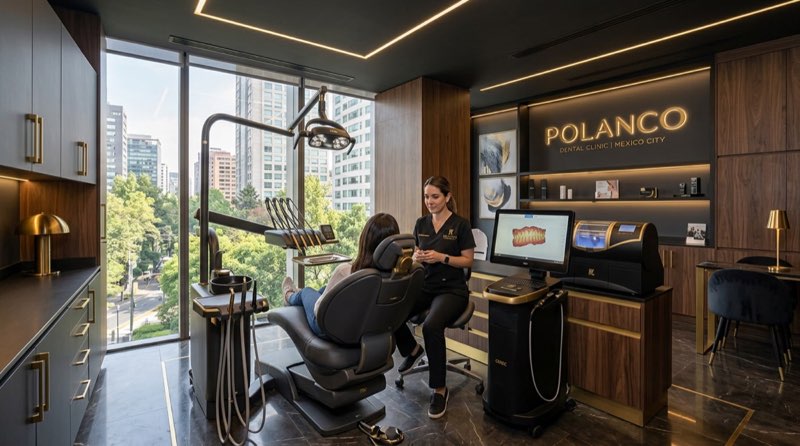
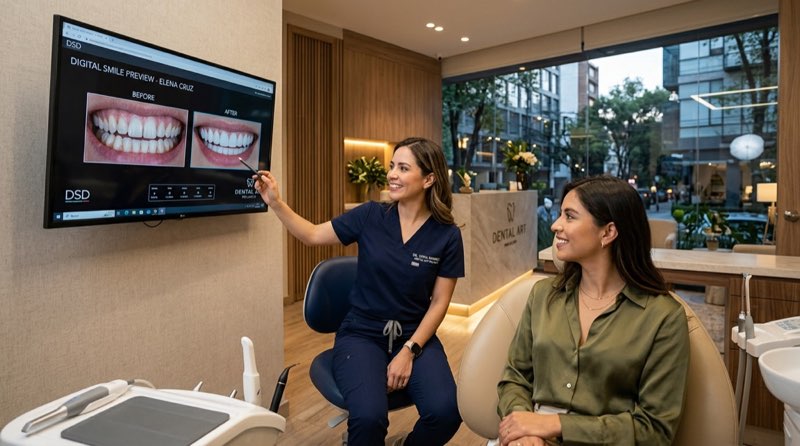
Every case starts with an intraoral 3D scan. No impression trays, no discomfort. The scanner creates a precise digital model of your mouth in minutes. From there, we overlay a digital smile simulation directly onto photographs of your actual face — so you can see the projected result before any tooth is prepared.
For complex cases, we add a 3D cone beam computed tomography scan. This reveals bone structure, root anatomy, and proximity to nerves — particularly important when smile design overlaps with implant placement or when the gum contour needs to be surgically adjusted.
Our photographic protocol — facial portraits, smile images, lateral profile shots — feeds into the digital model alongside the scan. Every proportional and symmetry decision is made digitally before we begin any preparation work.
What makes this workflow different at Clínica DrDiente is our in-house dental laboratory. Your veneers are not sent out to an external lab with a general instruction sheet. Our dental technician works directly from the digital plan, calibrating each piece between 0.3 and 0.5 mm. Adjustments happen same-day. Nothing gets lost between clinic and lab.
That precision is what separates a smile design that looks good in a photo from one that looks right in real life — from every angle, in every light, up close and across the room.
Schedule With the DrDiente Team
If you are considering smile design — whether you are a patient from Roma Norte or Polanco, or you are exploring dental tourism options in CDMX — the first step is a real diagnostic consultation. Not a quote. An actual clinical evaluation with our 3D scanner, our imaging technology, and a direct conversation about what is biologically realistic for your specific case.
I have spent 15 years building a practice around one principle: get the biology right first, and the aesthetics will follow. The results last that way.
If you want a second opinion, or you are ready to start your treatment, my team is here.
Talk to Dr. Ariza
Information from Clínica DrDiente
Aesthetic Dentistry & Oral Rehabilitation · COFEPRIS 2409132002A00145
This content is informational and is not a substitute for professional dental advice. Book an assessment for a personalized diagnosis.