Dr. Carlos Ariza's Take on Digital Smile Design
Every week at Clínica DrDiente — with locations in Roma Norte and Polanco, CDMX — patients sit down across from me and ask the same question: "Doctor, how will I know what my new smile looks like before you touch my teeth?" It's the right question. And honestly, it's the one that reshaped the way I practice dentistry.
With 15 years of clinical experience and thousands of smile design cases completed digitally, I can tell you this: the technology we use today doesn't just improve aesthetics. It changes the entire decision-making process. You see your result first. You approve it. Then — and only then — do we begin.
There's something most patients don't realize about how this design process actually works, though. And it has nothing to do with the software. I'll come back to that before we're done here.
What Most Dentists Don't Tell You About Digital Smile Design
Here's the honest truth that rarely gets discussed: digital smile design is a diagnostic protocol, not just a design tool. The technology is powerful — but it's only as good as the clinical judgment guiding the data underneath it.
In practice, the first thing I evaluate is never the teeth. It's the gums. If there's any inflammation, if the tissue looks red or puffy instead of that firm, healthy pink coral color, we stop right there. No exceptions. Placing veneers on inflamed gums is exactly like having a bad ingrown toenail — the surrounding tissue reacts, swells, bleeds, and if left untreated, can progress from simple gingivitis into periodontitis that starts consuming bone. I've seen it happen to patients who came to me after a disappointing result elsewhere. The restoration looked beautiful in photos. But the foundation was wrong from day one.
The same principle applies to cavities and bite problems. Active decay has to be resolved first. Misalignment or malocclusion gets corrected — with orthodontics if necessary — before we open any design software. I've had patients frustrated when I tell them we need to align their bite before touching the aesthetics. I understand the impatience. But porcelain on a compromised foundation doesn't last, and that outcome serves no one.
What nobody talks about, either, is the aesthetic trap that digital design creates when it's applied without proper facial context. I see this constantly: veneers that look perfect on a digital rendering but read as completely artificial in a real face. Teeth that are too square, too uniform, with zero natural character — what I'd describe as looking like chiclet gum tablets. Real teeth are not rectangular. They have gentle curves, surface texture, slight translucency at the incisal edge. The goal of any great smile design is that no one notices you had it done. They just think you look better. More rested. More like yourself.
Now — there's one more factor that most clinics don't account for in the design phase, and it's especially relevant if you're over 40. I'll come back to that after the case examples.
Our Clinical Experience: Real Cases
A 34-year-old patient came in wanting a complete transformation. She had reference photos, knew exactly what she wanted. But on first scan, I found mild gum recession on three lower teeth and clear signs of nighttime clenching wear on her upper anteriors. We couldn't start with veneers yet. We spent about six weeks on gum health, fitted her with a night guard, and only then began the digital planning process.
What the scan revealed was telling: she needed six veneers, not the ten another clinic had already quoted her. The digital design showed exactly where the proportional issue was concentrated. We fabricated a resin mock-up — a physical prototype she tried on in the same session — and she approved it without hesitation. The final result was completely natural. Her own mother didn't know she'd had anything done until she brought it up herself. That's the outcome we're always aiming for. Browse cases like hers in our before and after gallery at DrDiente.
A 52-year-old patient from the United States came through our dental tourism CDMX program for full-mouth rehabilitation. The 3D tomography revealed bone loss I had to account for carefully in the treatment plan. We used printed resin provisionals for five months — not for cost reasons, but because in complex rehabilitation cases I use provisionals to observe how the new bite actually functions before committing to final porcelain. Once the bite was stable and predictable across months of real use, we transitioned to final layered zirconia crowns. He flew home with a functional, natural-looking result. His complete 3D design file stays permanently archived in our system — which matters if he needs adjustments years from now.
A 28-year-old came in convinced she needed eight veneers. The digital facial analysis told a different story: the main issue was a gum asymmetry — one side sitting approximately 1.5 mm higher than the other. A minor laser gingivectomy corrected the gingival line. Then we designed four veneers, not eight. Same visual impact. Half the intervention. In my experience, this is one of the clearest real-world benefits of the digital workflow — it often shows patients they need considerably less treatment than they expected going in.
About that factor I mentioned for patients over 40: as we age, the upper lip drops slightly. The visible zone of the smile naturally narrows. A veneer design optimized for a younger face — with wide, prominent central incisors — can read as incongruous on someone in their mid-forties or fifties if the proportions aren't recalibrated for that anatomy. The digital protocol lets me model age-appropriate geometry from the start. It's a subtle adjustment that makes a significant difference in how natural the final result feels in a real face, not just on a screen.
Questions I Get Asked Most About Digital Smile Design
Is it normal to be anxious about how much they shave off the teeth?
Very normal — it's the number one concern I hear in consultation. The short answer: we remove very little. At Clínica DrDiente, tooth preparation is calibrated between 0.3 and 0.5 millimeters using our in-house digital laboratory. Less than half a millimeter, planned precisely before we touch anything. Preparation angles are also kept rounded — never sharp 90-degree edges, which would trap gum tissue and cause inflammation at the margin. The digital workflow is what makes that level of precision consistently reproducible case after case.
Does the procedure hurt?
Not during the procedure — we work under local anesthesia. Some patients experience sensitivity in the days following preparation, and we manage that with specific desensitizing protocols. Here's the clinical connection: the more precise the preparation, the less dentin exposure, and the less post-procedure sensitivity. Digital planning directly reduces that risk by preventing over-preparation from the start.
How long does it take from the first appointment to the final result?
It depends on your starting point — which is always the honest answer. If your gums and bite are already healthy, we can go from digital design to final placed veneers in three to four weeks. If we need to address underlying issues first, the timeline extends. That extra time isn't a complication. It's what protects the longevity of what we build. Rushing past the foundation is how you end up with beautiful veneers that fail in two years.
Porcelain or printed resin — which is actually better?
Neither is universally better. It depends on your clinical situation. Printed resin is the right call when budget is a real constraint (lasts roughly two years) or when we're in a complex rehabilitation phase and need to test how the new bite behaves before going final. Porcelain — whether feldspathic or lithium disilicate — is the definitive choice. When oral health is optimal and alignment is correct, porcelain can last up to 20 years in the mouth. That's the goal for most of our patients who come to us ready for the final step.
Is it worth doing digital planning for just two or three teeth?
For a very limited case, the full protocol might be more than necessary — but what I always do, regardless of scope, is the intraoral scan and facial photo analysis. The key in small cases is seamless integration: matching shade, translucency, and surface texture so the restored teeth are indistinguishable from the natural ones beside them. Digital reference makes that matching far more predictable. What matters is that the result looks complete, not corrected.
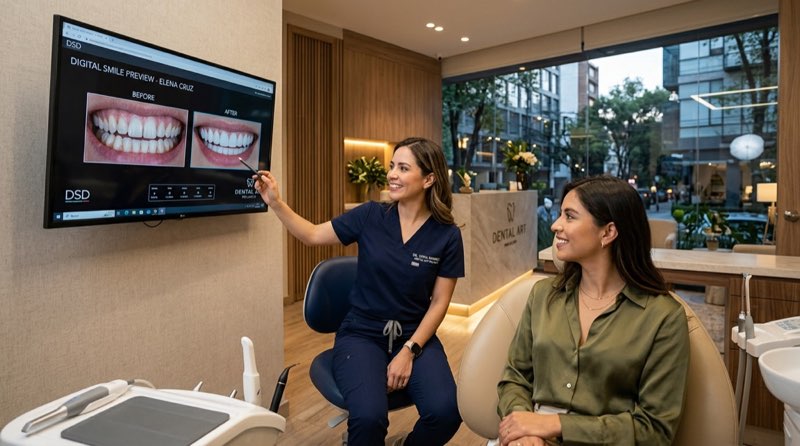
And here — finally — is what I mentioned at the very start: the mock-up is the most important step in the entire digital smile process. Not the 3D scan. Not the rendering. The physical resin prototype you try on in the chair and look at in a mirror. That's where design becomes reality — and where patients change their minds about things they were absolutely certain they wanted. Too long. Too wide. Too bright. Every one of those revisions happens before we prepare a single tooth. The technology doesn't just improve precision. It gives you the freedom to change your mind at zero clinical cost.
The Technology We Use at DrDiente for Smile Design
Our protocol at Clínica DrDiente integrates four components that function as a single diagnostic system:
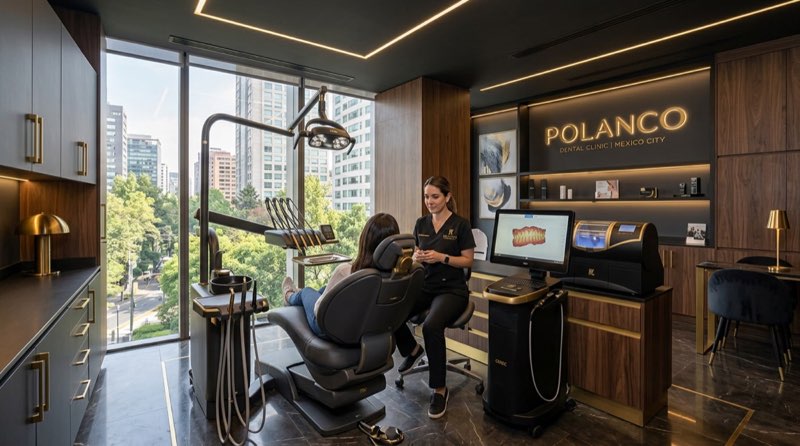
Intraoral 3D Scanner — We capture a precise digital model of your teeth and bite without physical impressions. No trays, no uncomfortable material. The scan takes approximately eight minutes and produces a model accurate enough to design on directly and transmit to fabrication without any intermediate steps.
3D Cone Beam Computed Tomography — For cases involving gum levels, bone structure, or bite assessment, the CBCT gives us a complete three-dimensional picture of everything a standard X-ray doesn't show. I use this for any patient with a history of bone loss, prior periodontal treatment, or cases where smile design is being combined with structural rehabilitation. It eliminates guesswork at the planning stage.
Standardized Photographic Protocol — Six facial angles, plus close-ups of the teeth at rest, smiling, and mid-speech. This is what feeds the facial proportion analysis — the step where we align the design with your actual facial geometry, not a generic "ideal smile" template from a catalog. Your face, mapped and measured.
In-House Digital Laboratory — This is where Clínica DrDiente stands apart from most clinics in CDMX. We design, mill, and quality-check everything in-house. That means direct translation from digital plan to physical restoration, calibrated at 0.3–0.5 mm precision, same-day adjustments when needed, and complete quality control at every stage. When we say the preparation is precise, we can verify that precision ourselves — not rely on a third party to interpret our instructions correctly.
Schedule with the DrDiente Team
If you've been thinking about changing your smile — or if you've had a consultation somewhere else and want a second opinion — I'd like to see your case personally. At Clínica DrDiente, the first design consultation includes the intraoral scan and facial photo protocol, so you leave that first appointment with a real picture of what's possible, not a general estimate based on a photo you emailed in advance.
We see patients from across Mexico City at our Roma Norte and Polanco locations. Through our turismo dental CDMX program, we regularly work with international patients who want world-class results at a fraction of what equivalent treatment costs in the United States or Canada. The technology is the same. The standard of care is the same.
You don't have to commit to anything at the first appointment. Come see what the technology actually looks like in practice. See a digital design of your own smile before we've touched a single tooth. That's where the conversation starts.
Talk to Dr. Ariza
Information from Clínica DrDiente
Aesthetic Dentistry & Oral Rehabilitation · COFEPRIS 2409132002A00145
This content is informational and is not a substitute for professional dental advice. Book an assessment for a personalized diagnosis.