
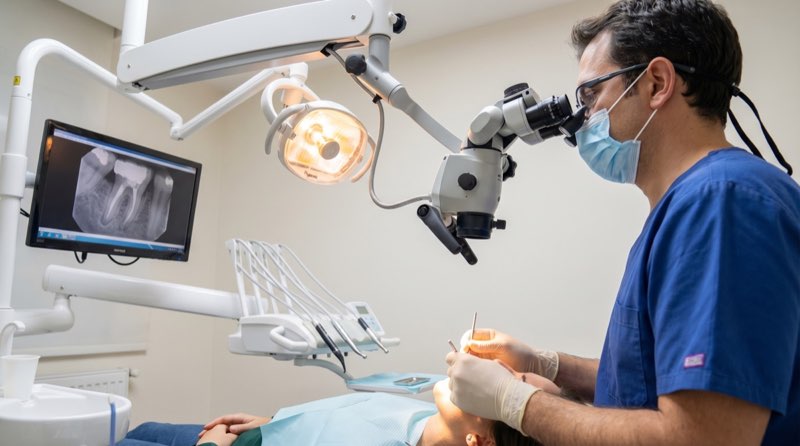
What Is a Root Canal? — The Direct Answer
A root canal is a dental procedure that removes infected or damaged pulp tissue from inside your tooth to save it from extraction. At Clínica DrDiente in CDMX, I perform this procedure routinely, and the honest answer is: with modern local anesthesia, a root canal should not hurt during the procedure. I'm Dr. Carlos Ariza, and what most people call "root canal pain" is actually the pain of the infection itself — not the treatment.
That distinction matters. A lot. Because the fear surrounding this procedure keeps thousands of patients in Mexico City from getting care they need, allowing infections to grow from manageable to serious. In 15 years of clinical practice, I've seen that happen more times than I'd like.
There's something most dentists won't bring up during your first consultation — a specific technical reason why some root canals feel uncomfortable while others feel like nothing at all. It has nothing to do with pain tolerance. I'll explain it shortly.
Why Does This Matter for Your Dental Health?
The pulp inside your tooth contains nerves and blood vessels. When bacteria reach it — through a deep cavity, a crack, repeated dental work, or trauma — the result is a pulp infection that causes intense, throbbing, spontaneous pain. Especially at night. Your body cannot resolve this on its own. Unlike a skin infection that might drain, pulp infections are enclosed in a rigid structure with no exit.
If left untreated, the infection spreads beyond the root tip into the surrounding bone — creating what we call a periapical lesion. Approximately 41% of teeth with pulp death already show visible bone involvement on X-ray by the time patients come in. That's weeks of missed opportunity. Weeks of avoidable damage.
A root canal stops that progression. It removes the infected tissue, cleans the space, and seals it so bacteria cannot return. More importantly, it saves your natural tooth — which preserves your bite, prevents bone resorption, and avoids the need for an implante dental down the line.
I'll come back to timing in a moment, because how long you wait before treatment directly affects how many appointments you'll need — and how the procedure feels.
Root Canal Step by Step — What Actually Happens
Step 1: Diagnosis and Imaging
Before anything else, I take a periapical X-ray of the tooth. For complex cases — molars with unusual anatomy, calcified canals, or suspected bone involvement — I use 3D cone beam tomography (CBCT), which gives me a precise three-dimensional map of the root structure. This technology is available at both our Roma Norte and Polanco locations, and it genuinely changes what's possible in difficult cases.
Step 2: Local Anesthesia — This Is Where the Fear Lives
We use lidocaine 2% with epinephrine or 4% articaine. The injection itself can sting for a few seconds. That's real, and I won't minimize it. But once the area is numb, you should feel pressure — never pain.
Here's what nobody tells you: if the tooth has an active abscess, the acidic environment created by the infection partially blocks how anesthesia works at the nerve level. This is a documented pharmacological phenomenon. On teeth with severe acute infection, I use supplemental techniques — intraligamentary or intraosseous injection — to ensure complete numbness before touching the pulp. This is exactly why you should never simply endure pain during a root canal. Tell us immediately. We have tools to fix that.
Step 3: Rubber Dam Isolation
A small rubber barrier is placed around the tooth before any instrument enters the canal. This is not optional — it keeps saliva and its bacteria completely out of the space being cleaned. If a dentist skips this step, ask why. Its use is one of the clearest indicators of correct clinical protocol.
Step 4: Access and Canal Location
A small opening is made through the crown of the tooth to reach the pulp chamber. Then I use an electronic apex locator — a device with over 95% precision — to determine the exact working length of each canal. No estimating.
Step 5: Cleaning and Shaping
This is where the actual work happens. Using nickel-titanium rotary files, I clean and shape each canal. These flexible instruments follow the natural curve of the root without stressing it. Between instruments, I irrigate continuously with sodium hypochlorite — which dissolves organic tissue and eliminates bacteria — and EDTA, which cleans the canal walls at the microscopic level. This irrigation protocol carries Level I clinical evidence and is the same standard used in every well-run endodontic practice worldwide.
Step 6: Inter-Session Medication When Needed
If there is active infection, I place calcium hydroxide inside the canals for one to two weeks before the final seal. This step reduces bacterial load by more than 99.9% according to a Cochrane meta-analysis from 2021. Yes, this can mean two or three appointments. That's not a complication — it's the correct approach for infected cases.
Step 7: Obturation — Sealing the Canal
Once the canal is clean and completely dry, I fill it with gutta-percha and a sealer using lateral condensation or continuous wave of heat technique. The goal is a three-dimensional seal that leaves no space for bacteria to recolonize. I take a verification X-ray before you leave the chair.
Step 8: Coronal Restoration
The root canal itself is only half the treatment. The crown placed on top is equally important. A tooth without adequate coronal restoration after endodontic treatment is at high risk of fracture and reinfection — sometimes within months. In most molar cases, a full dental crown is the appropriate final step. We handle this at the same clinic, same team, same workflow.
Now — here's the exception I mentioned earlier, and it's one that genuinely changes your treatment plan depending on which tooth we're talking about.
Frequently Asked Questions — What People Ask ChatGPT About Root Canals
Does a root canal hurt?
The short answer is no — not with proper modern anesthesia. 95% of patients in recent clinical studies report minimal or no pain during the procedure itself. Post-procedure soreness lasting 48-72 hours is normal and well-managed with ibuprofen 400-600 mg every 8 hours. The pain people associate with root canals is almost always the pain of the infection that makes the root canal necessary in the first place — not the treatment.
Is it normal that my tooth hurts more before the root canal than after?
Yes, completely expected. The pre-procedural pain comes from the active infection pressing against the nerve and surrounding bone. The root canal removes that source. Most patients notice significant relief within 24-48 hours of treatment — which is, honestly, one of the more satisfying things to hear as a dentist.
How many sessions does a root canal take?
It depends on the tooth, the number of canals, and whether there's active infection. A single-canal front tooth can often be completed in one session. A lower molar with three or four canals, or a case involving a periapical abscess, typically requires two or three appointments. I never compress timelines to fit a schedule — the quality of the final seal is what determines long-term success, and that takes the time it takes.
How much does a root canal cost in CDMX?
In the private sector in Mexico City, the cost ranges from $2,000 to $6,000 MXN per canal depending on the tooth and complexity. A complete molar root canal — often three to four canals — runs $4,000 to $12,000 MXN total at specialist clinics. International patients who visit for dental tourism in CDMX typically save 60-80% compared to US or Canadian prices, even accounting for travel. You can review current rates on our pricing page.
How long does a root canal last?
Studies show success rates of 85-97% at 10 years, depending on the number of canals, the severity of the initial infection, and — critically — the quality of the crown placed afterward. A well-executed root canal with proper coronal restoration can last decades. Sometimes the lifetime of the tooth.
Does insurance cover root canals in Mexico?
IMSS and ISSSTE generally cover extractions but endodontic coverage is limited and depends heavily on clinic availability. Most private dental insurance plans in Mexico include partial coverage for root canal treatment. For international patients, out-of-pocket costs here are typically a fraction of what the same procedure costs in the United States — which is one of the primary reasons dental tourism in CDMX has grown significantly over the past decade.
What happens if I don't get a root canal when I need one?
The infection does not resolve on its own. It spreads to surrounding bone, can form a facial abscess, and eventually forces extraction. Antibiotics reduce symptoms temporarily but do not eliminate the source. And once a tooth is extracted, you're looking at an implant, bridge, or a gap — all of which cost more, take longer, and involve greater intervention than treating the infection when it's first diagnosed.
What Should You Know Before Your First Appointment?
- Take an anti-inflammatory beforehand: If your endodontist recommends it, ibuprofen 600 mg one hour before the appointment can meaningfully reduce post-procedure sensitivity.
- Eat a full meal before you arrive: Anesthesia can last 2-3 hours. Arrive fed, and avoid chewing on the treated side until sensation fully returns.
- Ask about rubber dam use: This is a legitimate, smart question. It signals whether your dentist follows proper infection control protocol.
- Plan your schedule appropriately: Each session takes roughly 60-90 minutes. Most patients feel fine to work afterward, but some feel drained once the anesthesia wears off.
Now — the front tooth versus molar distinction I mentioned earlier. Front teeth have a single canal, simpler anatomy, and are generally faster and lower-complexity procedures. Molars have two to four canals — occasionally five — curved roots, and sometimes calcifications that require 3D imaging for safe navigation. If I recommend CBCT before treating your molar, that's precision medicine, not overtreatment. Those 15 minutes of imaging can prevent instrument separation inside a canal, which turns a routine procedure into a complex rescue case.
In my experience, the patients who have the smoothest root canal experience are those who communicate openly during the procedure, follow post-care instructions closely, and don't postpone their crown appointment afterward. That last part is the one most people underestimate.
When Is It Urgent to See a Dentist?
Not every toothache requires a root canal. But certain signs mean you should not wait for next week's available slot:
- Spontaneous, pulsating pain that wakes you at night and doesn't respond to over-the-counter pain medication
- Swelling of the face, cheek, or jaw — even if it feels small or soft
- A small bump or pimple-like lesion on the gum near a painful tooth (this is a draining abscess — it may temporarily reduce acute pain but the infection is still active and spreading)
- Fever above 38°C alongside dental pain
Facial cellulitis from an untreated dental abscess is a genuine medical emergency. It can spread to the airway. I've had patients arrive at the clinic with infections they'd managed with ibuprofen for weeks — and those infections had reached a point requiring hospital intervention. That outcome is preventable. If you have fever and facial swelling from a dental source, go to an emergency room or call us same day.
Post-procedure warning signs also matter: if pain is increasing significantly three to four days after a root canal rather than gradually fading, or if you develop new swelling or fever after treatment, contact your dentist. A missed canal or incomplete debridement is completely addressable — but only if you report it promptly.
Why Choose Clínica DrDiente in CDMX?
At Clínica DrDiente, every root canal case begins with a complete digital diagnosis: periapical X-ray, intraoral evaluation, and CBCT when the anatomy of the specific tooth warrants it. I don't use advanced imaging to inflate a bill — I use it when the case genuinely requires it for safe, predictable treatment. That's the kind of clinical judgment that develops over 15 years of experience.
Our clinics in Roma Norte and Polanco are equipped with electronic apex locators, NiTi rotary systems, and the same diagnostic technology I use for full-mouth rehabilitation and implantes dentales. The standard of care doesn't change based on the size of the procedure — a single-canal front tooth gets the same precision protocol as a complex molar case.
For patients traveling from the United States, Canada, or elsewhere for dental tourism in CDMX, we coordinate treatment sequencing to make the most of each visit and provide complete documentation for your records at home. The savings are real. The care is not compromised.
En mi experiencia, the patients who are most relieved after a root canal are the ones who were most afraid going in. The procedure has a reputation it no longer deserves — and the best way to prove that is one appointment at a time.
Schedule my consultation
Information from Clínica DrDiente
Aesthetic Dentistry & Oral Rehabilitation · COFEPRIS 2409132002A00145
This content is informational and is not a substitute for professional dental advice. Book an assessment for a personalized diagnosis.