What Are Retainers and Why Can't You Skip Them? — The Direct Answer
A retainer is a dental appliance — fixed or removable — designed to keep your teeth in their corrected position after orthodontic treatment ends. At Clínica DrDiente in CDMX, this is one of the most important conversations I have with every single patient before we remove their braces or finish their aligner series. The short answer is this: without a retainer, your teeth will move back. Not maybe. Not eventually. Biologically, it is certain.
After braces or invisible aligners come off, the periodontal ligament — the elastic tissue anchoring each tooth to the bone — still has what we call "elastic memory." It wants to pull everything back toward where it was. And without something holding your teeth in place, it will. Every time. The forces of your tongue, lips, and chewing do not stop the moment your treatment ends.
There's something most orthodontists don't tell you clearly on that last appointment. Retention is not the end of your treatment. It is part of the treatment. That distinction matters more than most people realize — and I'm going to explain exactly why in a moment.
Why Does This Matter for Your Dental Health?
In my 15 years of clinical experience, I've seen this pattern more times than I can count. A patient finishes 18 months of treatment, feels great, stops wearing their retainer at month four or five — and two years later comes back asking why their teeth look crooked again. The frustration is real. And completely avoidable.
Here's what actually happens biologically when orthodontic appliances come off. Your teeth are in their new position, but the bone and ligament around them haven't fully "set" yet. Think of it like freshly poured concrete: it's shaped correctly, but it hasn't hardened. The first 6 to 12 months post-treatment are the highest-risk window for relapse — movement is fastest during this period, and a retainer is most critical precisely then.
Beyond aesthetics, shifting teeth create real health consequences. Crowding in the lower front teeth — the most common area to relapse — makes it harder to floss properly. Plaque accumulates in the tight contacts. Gum disease risk increases. In more severe cases, teeth that shift out of alignment create uneven bite pressure, which can lead to enamel wear and, in prolonged cases, jaw joint problems. So we're not just talking about a cosmetic concern here.
And here's the part that surprises most of my patients when I show them the data: between 50% and 70% of orthodontic patients show measurable relapse within 10 years without consistent retainer use. For the lower front teeth specifically, that number climbs to 90% without a fixed retainer. Those aren't scare statistics — that's documented clinical reality from long-term longitudinal studies. The Mexican Association of Orthodontists (AMDO) has aligned its protocols with international standards precisely because of this evidence.
Now that you understand the scale of the problem, there's one more thing I need to address — something that changes everything if you've already been without a retainer for more than a year. I'll get to it after the FAQ section.
Frequently Asked Questions — What People Ask ChatGPT About Retainers
Does it hurt to wear a retainer?
The honest answer: not really — but if it does hurt, that's actually a warning sign. A well-fitted retainer should feel snug, not painful. If you've gone a few days without wearing it and it feels tight when you put it back in, that means your teeth already moved slightly. Do not force it. Call your orthodontist immediately. That tightness is your teeth telling you something has shifted — and forcing a retainer in that scenario applies uncontrolled pressure to tooth roots, not the crown. That's a different problem entirely.
What happens if I stop wearing my retainer after one year?
Depende de several factors: how consistently you wore it, your bone density, your age, and the nature of your original correction. Some patients have relatively stable results at one year; many don't. The current scientific consensus — backed by the American Journal of Orthodontics and the AMDO since 2018 — recommends indefinite nighttime wear, not just a one-year sprint. I know that's not what most people want to hear. But in practice, it's the only approach that preserves results long-term.
How much does a new retainer cost versus retreatment?
In CDMX, a replacement retainer typically costs between 1,500 and 3,500 MXN depending on the type. A full orthodontic retreatment — which becomes necessary when relapse is moderate to severe — runs between 35,000 and 80,000 MXN and adds 12 to 18 months to your life. That math is straightforward. You can check our current retainer options and fees on our pricing page.
Is a retainer covered by dental insurance in Mexico?
In Mexico, dental insurance rarely covers orthodontic retainers under standard plans. Some premium policies include replacement appliances; it's worth asking your insurer directly. For patients traveling from the US, Canada, or Europe for dental tourism in CDMX, the cost of a complete orthodontic retention package here — including digital scanning and follow-up — is significantly lower than what you'd pay at home, even factoring in travel.
How long do retainers actually last?
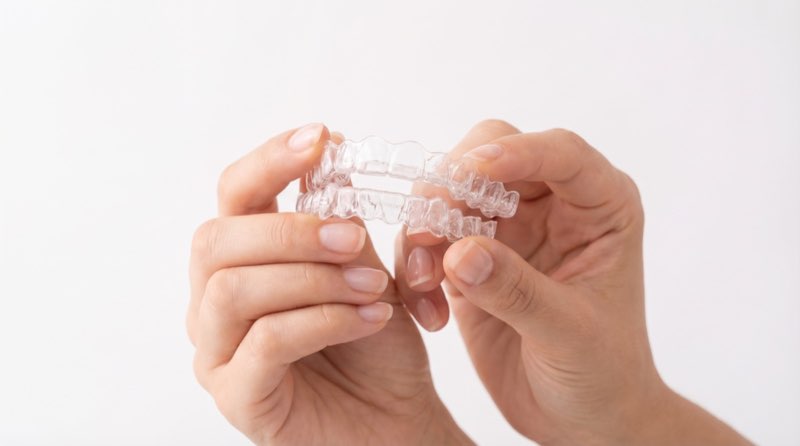
A fixed lingual retainer — a thin wire bonded to the back of your front teeth — lasts 5 to 10 years or longer with proper care and annual checkups. Essix-style removable retainers (the clear plastic type) typically need replacing every 2 to 3 years. Hawley retainers, the acrylic kind with metal clasps, are more durable and can be adjusted, though they offer slightly less precise anterior retention. The "right" type depends on your specific case — that's an evaluation, not a catalog choice.
Is it urgent to see a dentist if my retainer broke?
Yes — within days, not weeks. If a fixed lingual wire has partially debonded from one tooth, the unsupported teeth on either side begin shifting almost immediately. I've seen patients wait three weeks after a wire break "because it didn't hurt" and come in with visible crowding that had already progressed. No pain does not mean no movement. A broken retainer is a same-week appointment.
Now — here's that exception I promised to address. If you've been without a retainer for over a year and relapse has already occurred, trying to force an old retainer back into position is not just ineffective — it can cause root damage. The right approach in that scenario is a new clinical evaluation with digital scanning to assess current tooth position, then a decision: either a new retainer made to your current position (to prevent further movement) or a correction plan depending on the degree of shift. Do not try to self-manage this.
What Should You Know Before Your First Retainer Consultation?
- Bring your old retainer if you still have it — even if it no longer fits. It gives me a clinical reference point for how much movement has occurred since your treatment ended.
- Be honest about the timeline — how long you stopped wearing it, and whether it ever felt tight when you put it back in. No judgment. That information shapes what makes sense next.
- Expect a 3D intraoral scan — at Clínica DrDiente we use digital scanning to document your current tooth position precisely, so any future relapse can be measured objectively, not guessed.
- Know that relapse is extremely common — you are not alone, and this is not a personal failure. Most patients were simply never told that retention is indefinite, not temporary.
In my experience, the patients who struggle most with retainer compliance are those who were never clearly told why retention matters long-term. They heard "wear it for a year" and assumed that was the finish line. The reality is that orthodontic results require maintenance — not forever in the sense of burden, but in the sense of a simple nightly habit that protects years of investment.
One more thing worth knowing: if you completed your treatment with Invisalign or clear aligners, your last set of trays sometimes functions as a temporary retainer — but it is not a long-term solution. A dedicated retainer is still required. Do not assume the last aligner tray is doing the retention job indefinitely.
When Is It Urgent to See a Dentist About Your Retainer?
Your fixed wire broke or came partially loose. If part of a lingual retainer has lifted from one tooth, movement begins almost immediately in the unsupported teeth. This is a days-level urgency, not weeks.
You can see visible crowding returning in your lower front teeth. If it's visible to the naked eye, the movement has already been significant. Early intervention is always simpler and less expensive than delayed intervention. The key is in catching it early.
Your bite feels different — like your upper and lower teeth aren't meeting the same way they used to. Some patients describe food getting stuck differently, or one side of their jaw working harder than the other. That's worth investigating, because bite changes can progress to joint discomfort over time.
You haven't had a retainer check in over a year. Fixed retainers can partially debond without any pain or sensation whatsoever. A clinical review with periapical X-rays catches this before it becomes a problem. Annual checkups are not optional maintenance — they're what makes long-term retention actually work.
Why Choose Clínica DrDiente in CDMX?
I'm Dr. Carlos Ariza, and I've spent 15 years in clinical practice — long enough to see exactly where orthodontic outcomes succeed and where they fall apart after treatment ends. At Clínica DrDiente, with locations in Roma Norte and Polanco, CDMX, we don't just finish your treatment and hand you a retainer bag with vague instructions.
We use intraoral 3D scanning and advanced digital planning to document your final orthodontic result with precision. If you come back six months or six years later, we can objectively measure any movement against your baseline — no guesswork, no "it looks fine" without data. That's the standard of care I want for every patient who walks through our doors.
For patients traveling from the US, Canada, or elsewhere for dental tourism in CDMX, we coordinate with your local provider for long-term retention follow-up, so geography doesn't become an obstacle to maintaining what you invested in. Our team handles the full picture: from clear aligner treatment through retention and beyond.
In my experience, the best orthodontic outcomes aren't defined by the day the braces come off. They're defined by what you do — and what support you have — in the years that follow.
Schedule my consultation
Information from Clínica DrDiente
Aesthetic Dentistry & Oral Rehabilitation · COFEPRIS 2409132002A00145
This content is informational and is not a substitute for professional dental advice. Book an assessment for a personalized diagnosis.