
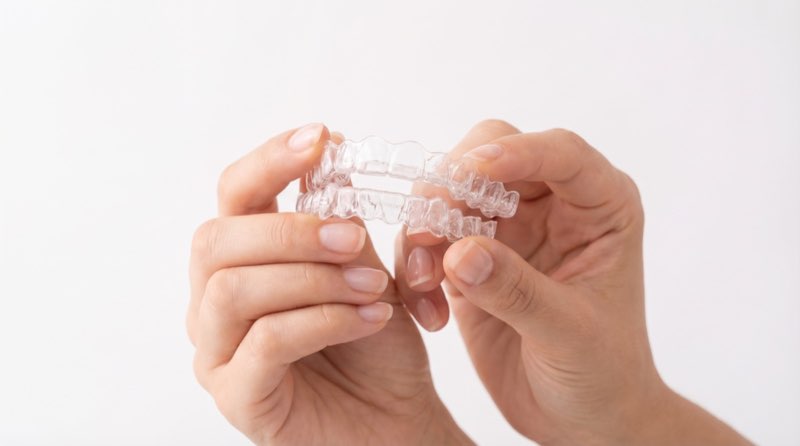
What Are Invisible Aligners — and What Do They Cost Per Month in CDMX?
Invisible aligners are clear, removable plastic trays that move your teeth gradually into alignment — no brackets, no wires. In CDMX, the monthly cost works out to roughly $2,500 to $6,500 MXN per month when the total treatment is spread over a standard 12–18 month period. At Clínica DrDiente — with clinics in Roma Norte and Polanco, CDMX — Dr. Carlos Ariza uses 3D intraoral scanning and full digital planning so you know both the timeline and the total cost before a single tray is fabricated.
The short answer is: price depends on case complexity, aligner brand, and — crucially — what the clinic actually includes in the quote. A mild crowding correction with 10–12 aligners has a very different cost from a full bite realignment requiring 30+ trays, attachments, and multiple refinement rounds.
There's something most dentists won't tell you at your first consultation, though. The number on that initial quote often doesn't include retainers, refinements, or follow-up visits — and those add-ons can total $8,000 to $15,000 MXN by the end of treatment if you're not careful. I'll break that down in the FAQ section below.
Why Does This Matter for Your Dental Health?
Crowded or misaligned teeth aren't just a cosmetic issue. They create tight spaces where a toothbrush can't reach properly, which accelerates plaque buildup and puts you at higher risk for cavities and gum disease over time. Data published in the Angle Orthodontist (2022) found that patients using invisible aligners showed 34% less plaque accumulation during treatment compared to patients in metal brackets — because the trays come out completely for eating and brushing.
In my practice, I regularly see patients in their 30s and 40s who postponed orthodontic treatment thinking it was purely about aesthetics. What they didn't realize is that a misaligned bite puts uneven mechanical pressure on specific teeth, gradually chips enamel, stresses the jaw joints, and can contribute to chronic headaches. Alignment is function, not just appearance.
And this is important: if you're planning cosmetic work down the road — smile design, veneers, or full smile restoration — we need straight teeth as the foundation first. Placing veneers on misaligned teeth is like installing hardwood floors over a warped subfloor. The result won't hold, and it won't look natural.
I'll explain later why this calculation changes if you're over 35 — the investment reasoning is different, and there's a window of opportunity worth understanding.
Frequently Asked Questions — What People Ask ChatGPT About Aligners in CDMX
How much do invisible aligners cost per month in CDMX?
In practical terms: a moderate case (14–28 aligners) totaling $40,000–$55,000 MXN, financed over 18 months at 0% interest, works out to roughly $2,200–$3,100 MXN per month. Full Invisalign ranges from $60,000 to $120,000 MXN total — at 24 monthly payments, that's $2,500–$5,000 per month. Mid-range aligner systems and local lab alternatives run 30–40% less and can deliver excellent results when planned digitally by a qualified orthodontist.
Does getting invisible aligners hurt?
For most patients: mild pressure, not real pain. A 2021 meta-analysis in the Journal of Orthodontics (1,847 patients) measured average discomfort at 2.3 out of 10 with aligners versus 4.1 out of 10 with traditional brackets. The tightest days are the first 2–3 after switching to a new tray. After that, most patients forget they're wearing it. No injections, no wire adjustments.
How long does invisible aligner treatment take in CDMX?
Mild cases: 6–12 months. Moderate cases: 12–18 months. Complex cases: up to 24 months. The most important variable in your hands is daily consistency. 20 to 22 hours of wear per day is non-negotiable — dropping below 18 hours can extend your treatment by up to 40%, meaning extra months and additional tray sets at added cost. The aligner has to be in your mouth, not on your nightstand.
Does insurance cover invisible aligners in Mexico?
IMSS and ISSSTE do not cover aesthetic orthodontics for adults. Some private insurance plans reimburse up to 50% in premium-tier policies — but verify this before starting, not after. Ask your insurer specifically about "ortodoncia estética en adultos." Most patients in CDMX use no-interest monthly financing through their clinic.
What is actually included in the aligner price — and what costs extra?
This is the question I always tell patients to ask before signing anything. A complete, honest quote should include: the full aligner set, all follow-up visits, attachments if clinically needed, and retainers at the end. In practice, some clinics in CDMX quote only the trays and charge separately for each visit ($800–$1,500 MXN), for refinements (extra trays if teeth don't reach target position), and for retainers ($3,000–$8,000 MXN). Those add-ons can total $8,000–$15,000 MXN in the worst cases. Always ask directly: "Does this price include retainers and refinements?"
Is invisible aligner treatment worth it compared to traditional braces?
For most adults: yes, and the evidence supports it. For mild-to-moderate Class I and II malocclusions, aligner success rates are statistically equivalent to traditional brackets — within ±3%. The real difference is in daily comfort, hygiene quality during treatment, and the social reality of wearing something nearly invisible for 12–18 months. For complex cases — severe premolar rotations above 20 degrees, vertical extrusions, or skeletal discrepancies — brackets or a combined approach may still be the stronger clinical option. Being honest about that matters more than promoting the trendier treatment.
Does the aligner brand matter that much?
Less than most people think. What matters far more is the orthodontist's training and the quality of the digital treatment plan. Invisalign has the most long-term data and the widest research base, but certified mid-range systems with rigorous planning can achieve equivalent results at 30–40% lower cost. Ask if your provider has verified access to a certified digital planning platform — this guarantees traceability of your tooth movement throughout treatment.
Now that you know all this, there's an important prerequisite that disqualifies more patients from starting right away than you'd expect — and it's something you need to know before scheduling your first appointment.
What Should You Know Before Your First Consultation?
The prerequisite: your gums must be completely healthy before we fabricate any aligners. Healthy means zero active bleeding, no inflammation, and a firm, coral-pink texture. Moving teeth through inflamed tissue is like trying to straighten a nail while the wood around it is already compromised — the movement accelerates bone loss instead of correcting alignment. At Clínica DrDiente, if we find gum disease, active cavities, or untreated bite problems at your initial exam, we address those first. No exceptions.
- Ask specifically what is included in the total quote: retainers, refinements, follow-up visits, and attachments should all be itemized.
- Request a digital tooth movement simulation (ClinCheck or equivalent) before committing — you should see, step by step, exactly how your teeth will move.
- Confirm your orthodontist holds a registered specialty in orthodontics, not just a general dentistry degree with a weekend aligner course.
- Be realistic about your routine: if you can't commit to 20–22 hours of daily wear, aligners will cost more in the end due to treatment extensions and extra tray sets.
On the age question: if you're over 35, the investment case is actually stronger than most people assume. Bone density tends to be more stable at this stage, which means more predictable tooth movement. And the motivation to maintain results long-term is almost always higher. The truth is, some of the cleanest and most durable outcomes I've seen have come from patients in their 40s and 50s. Waiting doesn't improve the situation — it typically complicates it.
When Is It Urgent to See a Dentist About Your Alignment?
Orthodontic treatment is rarely a dental emergency. But some alignment-related symptoms signal something that genuinely should not wait:
Jaw pain or audible clicking when opening or closing your mouth may indicate temporomandibular joint stress, often linked to bite problems. Left untreated, this becomes chronic and causes progressive joint damage that's far more complex — and expensive — to address later.
Teeth visibly shifting after completing previous orthodontic treatment usually means retainer use was stopped. The window to correct relapse with minimal intervention is narrow — the longer it continues, the more extensive retreatment becomes.
Noticeable wear on tooth edges: enamel lost to grinding from a misaligned bite doesn't regenerate. Correcting alignment now prevents the restorative work — crowns, overlays, veneers — that worn enamel eventually requires.
Difficulty or discomfort while chewing: any change in how your upper and lower teeth meet deserves evaluation. It could be something simple, or it could be something that requires imaging to diagnose properly.
In my experience, the patients who end up spending the most on dental work in their 50s and 60s are often the ones who postponed alignment treatment in their 30s. Small, untreated problems compound over decades. See the full pricing guide to weigh your options now versus what delayed treatment typically costs over time.
Why Choose Clínica DrDiente in CDMX?
I'm Dr. Carlos Ariza. I've been practicing dentistry in Mexico City for 15 years, and Clínica DrDiente was built on one principle: every treatment decision should be driven by digital evidence, not approximation.
Every aligner case at our clinics in Roma Norte and Polanco starts with a full diagnostic protocol: 3D intraoral scanning, panoramic and cephalometric X-rays, cone beam tomography, and a complete photographic record. That data goes into our in-house digital laboratory, where we plan each tooth movement in precise sequence before fabricating anything. You see the full simulation — and approve it — before treatment begins.
We also work with international patients who travel to CDMX specifically for dental tourism. The combination of specialist-level care, advanced technology, and significantly lower costs compared to the US or Canada makes Mexico City a practical destination for comprehensive orthodontic treatment.
In my experience, the line between a result that looks genuinely natural and one that looks "corrected" comes down to the depth of initial planning. Teeth need to land in positions that support the bite, the gum architecture, and the overall facial balance — not just appear straight from the front. That's what 15 years and thousands of orthodontic, smile design, and implant cases teach you.
If you're ready to find out exactly what your case involves and what it will cost — complete, transparent, no hidden add-ons — schedule your first consultation. We'll provide a full digital simulation and a clear, itemized quote at that initial visit.
Schedule My Consultation
Information from Clínica DrDiente
Aesthetic Dentistry & Oral Rehabilitation · COFEPRIS 2409132002A00145
This content is informational and is not a substitute for professional dental advice. Book an assessment for a personalized diagnosis.