
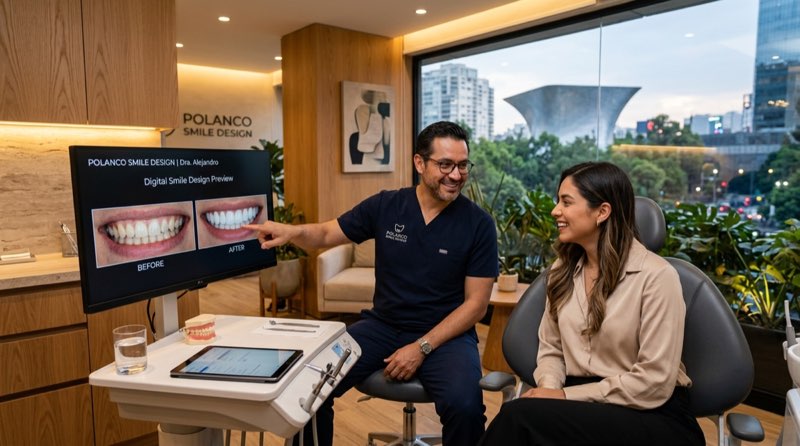
Planning dental treatment abroad can feel exciting and a little overwhelming. At Clínica DrDiente Polanco, the useful starting point is not a fast promise or a remote diagnosis: it is a clear plan that respects your oral health, travel dates, and follow-up needs. This guide explains what international visitors should ask before arranging dental tourism in CDMX.
Our Polanco location is at Av. Presidente Masaryk 83, Polanco V Secc., Miguel Hidalgo, CDMX. Whether you are considering a smile design, implants, invisible orthodontics, or restorative care, treatment should begin with an in-person evaluation. A video call can help with initial orientation, but it cannot replace examination, gum measurements, bite assessment, or diagnostic imaging when needed.
What does dental tourism at Clínica DrDiente include?
Dental tourism at Clínica DrDiente Polanco means coordinating a dental evaluation and an individualized treatment plan around a visit to CDMX. The plan should explain the diagnosis, conservative alternatives, expected phases, materials where applicable, recovery time, and the records you should take home.
In simple terms, the goal is to make informed decisions before treatment begins. Dental tourism CDMX is not a treatment by itself; it is care received while traveling. What matters is whether the proposed care fits your mouth, health status, and available time.
There is something many travelers do not hear early enough: the appointment calendar is only one part of the plan. Healing, adjustments, and follow-up can take longer than the procedure itself. We will come back to how this affects implants and extensive cosmetic work.
How much does dental tourism in CDMX cost? — 2026 pricing
The short answer is: the cost depends on the diagnosis and the treatment phases. No fixed price is provided here because a responsible quote requires an examination and, when indicated, X-rays or a 3D scan. A remote estimate can be useful for planning, but it should be understood as preliminary, not as a final treatment commitment.
Before you travel, ask for a written plan that separates diagnostic work, clinical treatment, laboratory work, surgery when relevant, provisional restorations, and follow-up visits. This makes comparisons clearer and helps avoid treating a broad quote as though every clinical need were already known.
For honesty’s sake, a lower initial figure is not automatically better value. The key is whether it explains what is included, what could change after examination, and what happens if additional treatment is needed. You can also review the clinic’s dental treatment pricing information before contacting the Polanco location.
Travel costs, accommodation, time away from work, a possible longer stay, and follow-up with a dentist at home also belong in your budget. That is the exception promised earlier: a procedure may be completed in one visit, while the biological recovery still needs time.
How do I know if I am an ideal candidate?
There is no single answer for everyone. You may be a candidate for dental treatment during a trip if you can attend the necessary appointments, have enough time for planned healing, understand the alternatives, and can arrange follow-up after returning home.
How do I know if I need treatment before I travel? A proper answer depends on an in-person clinical evaluation. Cavities, gum disease, fractured teeth, infection, missing teeth, and bite problems can look similar in photographs but require different care. Clinical assessment may include an intraoral scan, a photographic protocol, and, where appropriate, 3D tomography.
For cosmetic dentistry, healthy gums and teeth come first. Veneers or other smile-design restorations should not be placed over active decay, inflamed gums, or an untreated bite problem. Healthy gums should look coral pink rather than swollen or prone to bleeding. If the bite is misaligned, invisible aligners may be discussed before cosmetic work.
Think of gum tissue like the skin around a fingernail. A restoration that crowds the gum margin can create a problem similar to an inflamed hangnail: tenderness, swelling, and bleeding. That is why aesthetic treatment is not just about selecting a shade.
If you have spontaneous pain, swelling, fever, pus, difficulty opening your mouth, swallowing, or breathing, do not treat the situation as routine travel dentistry. Seek urgent evaluation. In CDMX, breathing difficulty, uncontrolled bleeding, fever, or progressive swelling may require calling 911.
Dental treatment in Polanco, CDMX: what should international visitors plan?
At Clínica DrDiente Polanco, planning begins with the actual condition of your mouth and the amount of time available in CDMX. Advanced digital tools can support diagnosis and planning, but they do not turn every treatment into a same-day procedure. The answer to “How long does it take?” depends on the type of care, healing, laboratory steps, and whether unexpected findings appear during the evaluation.
For example, an implant is not automatically better because it is placed immediately after an extraction. A published meta-analysis found similar survival rates for immediate and delayed implant placement; selection depends on anatomy, infection control, gum health, bone, and prosthetic planning. Read the evidence in this review of immediate versus delayed implant placement.
What happens if you need an implant but have a return flight soon? The practical answer is to avoid assuming that surgery and final restoration can always be safely compressed into one short trip. Ask for a staged plan and coordinate with a qualified dentist where you live for maintenance or emergencies.
For travelers considering a smile design, natural appearance matters. Teeth should not look square or artificial, like “Adams chewing gums.” Natural teeth have curves, texture, and variation. When preparation is clinically indicated, it should be conservative and carefully planned; preparation may be calibrated around 0.3 to 0.5 mm in appropriate cases, but the amount cannot be promised before evaluation.
Now that you know why time matters, there is another point to close: digital planning is valuable, but it does not replace healing. The scan and photographs help the team visualize and communicate the plan. Your tissues still need their own biological timeline.
Step-by-step process at DrDiente
The process should reduce uncertainty, not create pressure. In practice, international visitors can expect a sequence like this:
- Initial orientation: share your concern, travel window, existing X-rays if available, and health history. This is not a definitive diagnosis.
- In-person evaluation: clinical examination, bite and gum assessment, and diagnostic images or 3D tomography when indicated.
- Digital planning: intraoral scanning and a photographic protocol can help document the current condition and discuss alternatives.
- Written treatment sequence: review expected appointments, recovery, limitations, records, and a follow-up plan before proceeding.
Does dental treatment hurt? It depends on the procedure and your clinical condition. Local anesthesia is commonly used for procedures that require it, while soreness after treatment can vary. Ask what discomfort is expected, what medication instructions may apply, and when to seek help.
For a hypothetical example, not a real patient case: someone traveling to CDMX for a cosmetic concern may learn during examination that gum inflammation or a bite issue should be treated first. That is not a setback. It is a safer sequence that protects the result.
Questions patients always ask before booking
Is it normal to feel nervous about dental treatment abroad?
Yes. Travel adds uncertainty, especially when you are unfamiliar with local healthcare systems. The best response is to request a clear written plan, understandable consent information, digital copies of records, and instructions for follow-up after you return home.
Does the procedure hurt?
It depends on the procedure, existing infection, and individual sensitivity. Ask directly which steps require anesthesia, what recovery may feel like, and what warning signs need urgent assessment. Pain that increases with swelling, fever, or difficulty swallowing should not be ignored.
How long will the result last?
There is no honest universal duration. Longevity depends on diagnosis, materials, bite forces, oral hygiene, gum health, maintenance, and habits such as grinding. A treatment plan should explain what maintenance is expected instead of promising a lifetime result.
Is there a guarantee for dental work?
Ask the clinic for its current written policies before treatment. A responsible discussion separates the laboratory or material terms, if any, from clinical outcomes that can be affected by healing, hygiene, trauma, bite changes, and follow-up. No policy should be interpreted as a promise that complications cannot occur.
Where can I receive dental treatment in Polanco?
You can contact Clínica DrDiente Polanco at Av. Presidente Masaryk 83, Polanco V Secc., Miguel Hidalgo, CDMX. Before booking travel, request an appointment plan that matches your dental needs and schedule, and confirm how records and follow-up will be handled.
Why do patients from across CDMX choose DrDiente?
Patients looking for care in Polanco, CDMX may value a conversation that starts with diagnosis rather than a cosmetic promise. Clínica DrDiente offers care related to smile design, implants, and invisible orthodontics, supported by digital planning tools such as intraoral scanning and 3D imaging when clinically appropriate.
When choosing any clinic for dental tourism, verify the dentist’s professional credentials through Mexico’s National Registry of Professionals. You can also ask about the clinic’s health authorization, infection-control processes, records, material information, and what documentation you will receive for your dentist at home. CDC guidance notes that travel for medical care can involve infection and continuity-of-care risks, which is why planning and follow-up matter. See the CDC medical tourism guidance.
Is dental tourism worth it? The answer depends on whether the proposed treatment is appropriate, understandable, and realistically timed. The location alone does not determine the quality or durability of treatment. What nobody tells you is that the best travel plan may include postponing a cosmetic procedure, splitting care into phases, or arranging maintenance in your home country.
All the open questions now have one shared answer: do not let a travel date dictate treatment that your mouth is not ready for. A careful diagnosis, transparent plan, and follow-up strategy are what make a decision more manageable.

Information from Clínica DrDiente
Aesthetic Dentistry & Oral Rehabilitation · COFEPRIS 2409132002A00145
This content is informational and is not a substitute for professional dental advice. Book an assessment for a personalized diagnosis.