What's Included in Dental Tourism at Clínica DrDiente?
At Clínica DrDiente, our dental tourism program starts before you ever step on a plane. I'm Dr. Carlos Ariza, and across 15 years of treating international patients at our Roma Norte and Polanco, CDMX locations, I've learned that the difference between a great experience and a stressful one almost always comes down to preparation. Here's what you actually get: a virtual consultation where we review your existing X-rays and photos, a full digital diagnostic protocol on arrival — intraoral 3D scan, cone-beam CT, clinical photography — the treatment itself using internationally certified materials, and complete digital records to take home in English and DICOM format so your dentist back home can follow up.
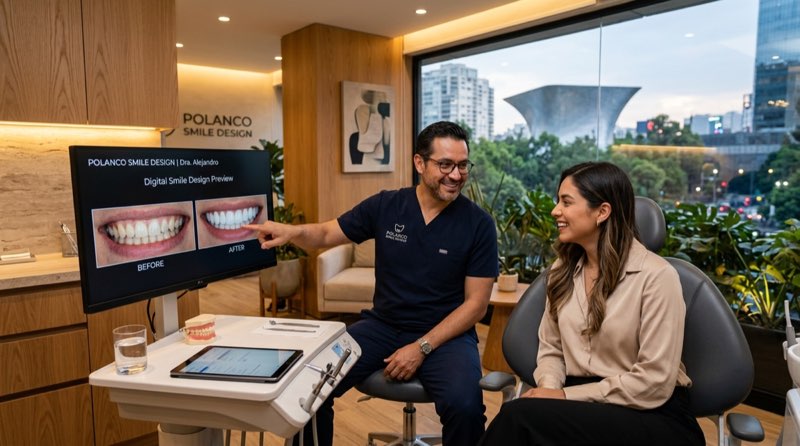
The most requested procedures from US patients are dental implants, full-mouth rehabilitation, and smile design with porcelain veneers. Everything is planned digitally in our in-house lab before we touch a single tooth. We work with Nobel Biocare, Straumann, and Zimmer implants — internationally certified brands with warranties that travel with you across the border.
I hear the same question every week from patients reaching out from Houston, Los Angeles, or New York: Is it actually safe to get dental work done in Mexico? The short answer is yes — in the right clinic, with the right approach. But there's one thing that almost no dental tourism guide ever mentions, and it's the factor that most determines whether your result holds up long-term. I'll get to it shortly.
How Much Does Dental Tourism in CDMX Cost? — Real 2026 Prices
To be honest, cost is what puts turismo dental CDMX on the map for most American patients. The savings are real and documented. A single dental implant with crown costs $900–$1,800 USD at a quality CDMX clinic — compared to $4,000–$6,000 USD for the same procedure with equivalent brands in the US. That's a 50–70% reduction, enough to cover flights, hotel, and a few days exploring the city and still come out significantly ahead.
At Clínica DrDiente, we offer an initial evaluation — virtual before your trip or in person at our Roma Norte or Polanco locations — and financing plans for multi-procedure cases. Realistic price ranges for 2026:
- Single implant + crown: $900–$1,800 USD
- Full smile design (8–10 porcelain veneers): $3,500–$6,000 USD
- All-on-4 full arch rehabilitation: $8,000–$14,000 USD per arch
- Zirconia crown per unit: $400–$700 USD
What I need to say plainly: never choose a clinic based on the lowest quote alone. I've had patients come to us to fix treatments that failed elsewhere — and the cost of repair exceeded what quality care would have cost the first time. More on the specific red flags that actually matter coming right up.
How Do I Know If I'm the Right Candidate for Dental Tourism?
The answer depends on what you need and how much time you can realistically plan. Dental tourism works well for procedures completable in one trip of 5–10 days, or across two planned visits. It works less well for treatments requiring continuous follow-up — like clear aligners or Invisalign, which need adjustments every 4–6 weeks. For that, I'd honestly recommend working with a local provider unless you plan to visit CDMX regularly.
Good candidates for dental tourism at DrDiente are patients who:
- Need implants, crowns, or veneers — all completable in one or two planned trips
- Are in good general health with no uncontrolled systemic conditions that complicate surgery
- Can build in 2–3 extra recovery days before flying home after any surgical procedure
- Are willing to identify a local dentist back home for long-term follow-up
One thing that immediately disqualifies a patient for cosmetic work — and this is non-negotiable — is active gum disease. If your gums are inflamed, bleeding, or not a healthy coral-pink color, we don't move forward with veneers or smile design. It's exactly like tiling over a rotten floor. It will fail, and it will hurt. The same goes for untreated cavities or significant bite misalignment — those get corrected first, always. Any clinic that skips this conversation is one to avoid.
Here's what most patients never think to ask when comparing clinics — and it's the single most important predictor of long-term treatment success. I'll walk you through it in the next section.
Step-by-Step Process at DrDiente
Before any treatment begins, we build a complete digital picture of your mouth. At Clínica DrDiente this means an intraoral 3D scan, a cone-beam CT (CBCT), and a full clinical photographic protocol — for every patient, no exceptions. I use this data to plan every procedure digitally before a single instrument touches your teeth. For implants, I know the exact bone density, placement angle, and depth before surgery day. For veneers, preparation thickness is calculated to the tenth of a millimeter. Our preparations are calibrated between 0.3 and 0.5 mm in our own in-house lab — less than half a millimeter, personalized for each individual tooth.
For a typical implant case, the timeline looks like this:
- Before you arrive: Virtual consultation with your existing X-rays and photos. Written quote. Personalized treatment plan.
- Day of arrival: In-person evaluation, CBCT, intraoral scan. Confirm or refine the plan together.
- Day 2–3: Implant placement under local anesthesia. In eligible cases, a provisional crown is placed immediately.
- Days 4–7: Healing observation. We clear you before you fly.
On a second trip 3–6 months later, we place the final crown — zirconia, E.max porcelain, or PFM depending on your case. You leave with everything: DICOM files for the CT scan, implant brand and lot number, and bilingual treatment notes your dentist back home can actually read. This is the thing I promised to explain. Continuity of care after returning home is the real risk in dental tourism — and complete clinical documentation is exactly how you eliminate it. Without proper records, even excellent work becomes fragile the moment anything needs attention back in the US.
Questions Patients Always Ask Before Booking
Does dental work in CDMX hurt? What's recovery like?
Implant surgery with proper anesthesia is essentially painless during the procedure itself. Post-surgical discomfort is normal for 2–4 days and is managed well with standard anti-inflammatories. I recommend planning at least 2 full rest days in CDMX after any surgical procedure before sightseeing or flying. Pressurized cabin travel doesn't contraindicate implants, but I want to see you before you board — just to confirm healing is progressing normally.
What if something goes wrong after I'm back in the US?
Most minor issues — occlusion adjustments, mild sensitivity — are handled by any local dentist if you have your documentation. For implant concerns specifically, Nobel Biocare and Straumann carry international warranties valid through authorized dealers in the US. We send you home with the implant lot number and warranty card at discharge. Major complications are uncommon — peer-reviewed meta-analyses put the rate below 5% — and are manageable when proper records exist.
How long do the results last?
Implants show a 95–98% success rate at 10 years in peer-reviewed literature. Porcelain crowns and veneers last up to 20 years with good home hygiene and professional cleanings every 4–6 months. Long-term success depends as much on what you do at home as what we do in the clinic.
How do I verify a CDMX dental clinic is legitimate before I book?
Ask for the specialist's cédula profesional (professional license number) and verify it at the SEP government registry — it's a public database, free to search. Request COFEPRIS certification (Mexico's federal health regulator) and the autoclave sterilization log. Any clinic that hesitates on these is a warning sign. If the price is 80% below local market rate, that's not a deal — that's a red flag. Quality implant brands like Nobel and Straumann have a real wholesale cost. There is no version of legitimate implant surgery at $200 USD.
There's one last thing worth knowing before you decide — something about what dental tourism success actually looks like in practice, beyond just saving money today.
Why Patients from Across the US Choose Clínica DrDiente
I'll be direct: patients come for the savings. They come back — or they refer their friends — because the experience matched what was promised. In 15 years of practice in Roma Norte and Polanco, CDMX, I've treated patients from Texas, California, New York, Florida, and most states in between. What they tell me afterward isn't about the price. It's about feeling genuinely informed and cared for at every step of the process.
In my experience, the patients with the best long-term outcomes are the ones who arrived prepared: records organized, implant brand researched, questions ready. Dental tourism done with intention is one of the most cost-effective health decisions a person can make. Done carelessly — picking the cheapest option, skipping documentation, flying home the morning after surgery — it becomes expensive twice over. My job is to make sure that doesn't happen to you.
What sets Clínica DrDiente apart in practice:
- Advanced diagnostics on every patient: 3D scanner, CBCT, digital planning — clinical standard, not an optional upgrade
- In-house digital lab: same-building ceramist, same-day adjustments, CAD/CAM precision for every restoration
- English-speaking staff and bilingual treatment records for seamless coordination with your US dentist
- Internationally certified implant brands with warranties honored by authorized dealers in the US
Real documented cases — before and after, no filters — are at our results gallery. That's where I'd start if I were the one making this decision.
See real dental tourism cases in CDMX Schedule my evaluation
Information from Clínica DrDiente
Aesthetic Dentistry & Oral Rehabilitation · COFEPRIS 2409132002A00145
This content is informational and is not a substitute for professional dental advice. Book an assessment for a personalized diagnosis.