How Long Does Pain Last After a Dental Implant? — The Direct Answer
After a dental implant procedure, most patients experience moderate discomfort for 5 to 7 days, with peak intensity occurring in the first 72 to 96 hours. The short answer is: this pain is normal, manageable, and temporary — provided it follows the right trajectory. At Clínica DrDiente in CDMX, this is one of the first things I walk every patient through before any surgery takes place. I'm Dr. Carlos Ariza, and I'd rather give you the honest picture than the polished version.
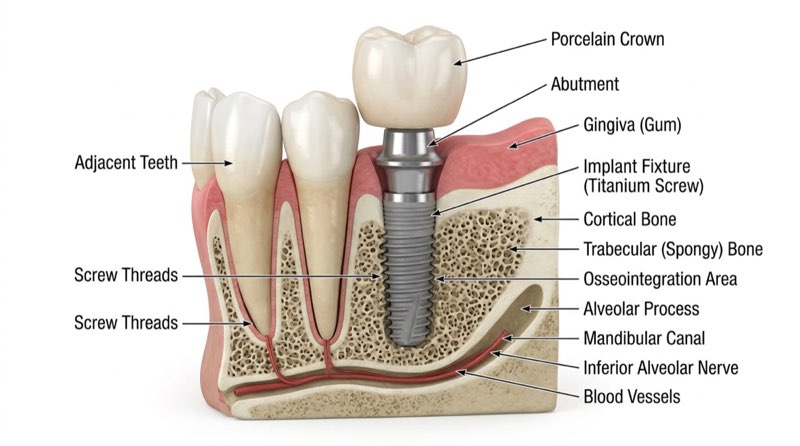
Your body responds to implant surgery the same way it responds to any surgical trauma: with inflammation. That's not a problem — that's your immune system doing exactly what it's supposed to. The titanium fixture placed in your jawbone is a foreign object, well-tolerated, but your body still needs time to build around it and eventually fuse with it. That process is called osseointegration, and it takes 3 to 6 months. The pain resolves much sooner than that.
There's something most dentists don't fully explain during that first consultation — and it directly affects how comfortable your first week at home will be. I'll get to that in a moment.
Why Does This Matter for Your Dental Health?
Pain management after a dental implant is not just about comfort. It's about protecting the healing process itself. When pain is uncontrolled, patients stop eating well, sleep poorly, and start making choices they shouldn't — touching the surgical site, eating too soon, or skipping antibiotic doses because they feel okay in the moment.
What matters is that the first 96 hours set the foundation for whether your implant integrates successfully or not. Swelling compresses the soft tissue around the implant. Mild bone resorption in the first 48 to 72 hours is physiological — not alarming. But if infection enters this window, or if the blood clot at the surgical site is disrupted, healing becomes significantly more complicated.
In my practice, I've seen patients arrive on day 8 convinced their increasing pain was just normal soreness. In two of those cases, we were dealing with early periimplantitis — a bacterial infection of the tissue surrounding the implant — that required immediate intervention to avoid losing the fixture entirely. We caught both in time. But only because they came in and didn't wait.
And this is exactly what I mentioned earlier. The thing most dentists don't explain clearly enough: take your first ibuprofen dose before the local anesthesia wears off — not after the pain starts. Anti-inflammatories work proactively. Once the inflammatory response is fully active, it takes longer to bring under control. Starting at hour 4 post-surgery, on schedule, makes a measurable difference in how that first night goes.
Now, there's an important exception to what I just described — and it specifically applies if you're over 45, have had a bone graft, or if your case involved a sinus lift. I'll explain exactly what changes after we cover the most common questions patients bring to their consultations.
Frequently Asked Questions — What People Ask ChatGPT and Google
Is it normal to feel pain after a dental implant?
Yes, completely normal. The discomfort is an acute inflammatory response triggered by the surgical procedure — not a sign something went wrong. Between 85 and 90% of patients report mild to moderate pain in the first week, managed well with standard anti-inflammatory medication. Only 10 to 15% experience more intense discomfort, usually when bone grafting or sinus elevation was part of the surgery. If your pain feels proportional to what was done, you're in normal recovery territory.
How long does pain last after a dental implant?
For a single-tooth implant without complications, pain typically resolves within 10 to 14 days. The most intense period is the first 72 to 96 hours. By day 5 to 7, most patients return to their normal routine. This is where the exception I mentioned comes in: when bone grafting or sinus lift procedures were involved, discomfort can extend to 3 to 4 weeks. That is not a complication — it's the biology of bone regeneration working as it should. The timeline is longer, but the healing pattern is the same.
Does getting a dental implant hurt?
The procedure itself? No — not while it's happening. Local anesthesia is highly effective for implant surgery. At Clínica DrDiente in Polanco and Roma Norte, we use long-acting anesthetic formulations that extend postoperative comfort for several hours. For anxious patients, sedation options are available. To be honest — the anticipation is almost always worse than the reality. What you'll feel afterward is real, but it's temporary and manageable with the medications we prescribe.
How much does a dental implant cost in CDMX?
In Mexico City, a dental implant typically ranges between $8,000 and $25,000 MXN per implant, depending on case complexity and whether bone grafting is required. This price difference is one of the main reasons dental tourism in CDMX keeps growing — patients from the US and Canada often save 50 to 70% compared to home-country pricing, while receiving care from certified specialists. At Clínica DrDiente, postoperative follow-up appointments are included in the treatment cost.
Is post-implant pain ever a dental emergency?
Depends on what you're experiencing. Normal post-surgical pain that decreases daily is not an emergency — manage it with your prescribed medication and keep your scheduled follow-ups. What IS urgent: pain that increases after day 3, fever above 38°C (100.4°F), pus or discharge around the implant, any sensation that the implant is moving, or persistent numbness in the lip or chin. These require same-day contact with your clinic — not a wait-and-see approach.
Does insurance cover dental implants in Mexico?
IMSS and ISSSTE do not cover dental implants as a standard benefit. Most private health insurance plans in Mexico classify implants as cosmetic and exclude them. The most practical path for many patients is clinic-based financing plans that spread the cost over several months without requiring full upfront payment.
What You Should Know Before Your First Consultation
Coming in informed makes the entire process smoother — for you and for the clinical team. Here's what I evaluate in every implant consultation at Clínica DrDiente:
- Bone density and volume: We use 3D cone-beam tomography to assess your jawbone before placing anything. This determines whether bone grafting is needed and directly affects your recovery timeline.
- Full health history: Uncontrolled diabetes, active autoimmune conditions, and osteoporosis can affect how well the implant integrates. Smoking is a significant risk factor — it reduces blood flow to the healing site and is one of the leading causes of implant failure.
- Realistic treatment timeline: From placement to final crown, the complete process takes 3 to 6 months. Some cases qualify for immediate loading protocols, but not everyone does — and I'll tell you honestly if yours qualifies.
- Home care protocol: Diet restrictions, medication schedule, physical activity limits — we go through all of it before you leave the clinic. The first 14 days matter enormously.
One more thing that rarely gets enough emphasis: gum health is non-negotiable before implant surgery. Active gum disease or significant inflammation increases the risk of implant failure substantially. We always treat the soft tissues first. This isn't excessive caution — it's giving your implant the biological environment it needs to integrate properly.
In my experience, the patients who recover with the least difficulty are the ones who were genuinely prepared — not the ones who had a brief consultation and went straight to surgery. Good diagnostics protect you. Every implant case at Clínica DrDiente starts with a 3D scan and a complete intraoral evaluation, not a visual inspection and a handshake.
There's one additional consideration that applies specifically to patients who've recently had a tooth extracted — and the timing of that extraction changes what we plan next. I'll cover that below.
When Is It Urgent to See a Dentist?
Most post-implant discomfort resolves at home with medication and rest. These signs, however, require immediate attention — don't wait for your next scheduled appointment:
- Pain that increases after day 3 instead of steadily decreasing
- Fever above 38°C (100.4°F) — suggests active infection
- Pus or unusual discharge around the implant site
- Persistent numbness or tingling in the lip, chin, or tongue
A mobile implant is always an emergency. A properly integrating implant does not move — period. If you feel any movement when touching the implant, call immediately. And if your implant was placed in the upper jaw and you're now experiencing sinus pressure or nasal congestion that wasn't there before, mention that to your clinic. In rare cases, the implant may have extended into the sinus cavity.
The key is the direction of your pain. It should follow a downward curve — less intense each day. When that curve reverses, something needs to be evaluated. Early detection is what saves an implant when complications arise. I'd rather see a patient three times unnecessarily than miss something that could have been caught on day 4.
For patients who've had a recent extraction: placing an implant immediately after the tooth is removed (same session) is possible in select cases and shortens overall treatment time. But it requires adequate bone volume and zero active infection at the extraction site. This is evaluated case by case with 3D imaging. If conditions aren't ideal, waiting 3 to 4 months lets the bone stabilize — the final result is identical, just a longer path. We tell you which scenario applies during your consultation, not after you're already in the chair.
Why Choose Clínica DrDiente in CDMX?
I'm Dr. Carlos Ariza, and I've been placing implants for 15 years. What I've built at Clínica DrDiente — with locations in Roma Norte and Polanco, CDMX — is a protocol-driven approach to implant dentistry based on honest diagnostics, advanced technology, and zero shortcuts.
Every implant case at our clinic begins with a 3D tomography and intraoral scan. We map bone density, adjacent tooth positions, nerve proximity, and gum health before a single instrument touches your jaw. Our digital planning process means the surgery is fully designed before it begins — no improvising once we're inside.
We also welcome patients traveling for dental treatment in CDMX from the US, Canada, and Europe. Our coordination is built so international patients can complete as much as possible during their visit, with a clear remote follow-up plan established before they fly home.
If you're considering an implant — or you're already in recovery and have questions about what you're feeling — reach out. The first consultation gives you a clear, honest picture of where you stand and what your specific timeline looks like.
Schedule My Consultation
Information from Clínica DrDiente
Aesthetic Dentistry & Oral Rehabilitation · COFEPRIS 2409132002A00145
This content is informational and is not a substitute for professional dental advice. Book an assessment for a personalized diagnosis.