What's Included in a Zirconia Crown at Clínica DrDiente?
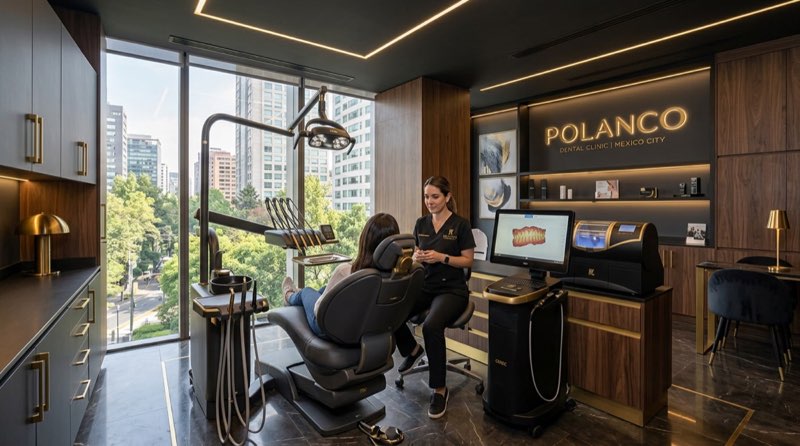
At Clínica DrDiente, a zirconia crown covers the complete process — not just the tooth cap. From your first appointment at our Roma Norte or Polanco, CDMX locations, you get a digital diagnostic workup, intraoral 3D scan, custom crown fabrication in our own in-house lab, a provisional crown while you wait, and final cementation — all supervised directly by Dr. Carlos Ariza. No handoffs. No surprises. Every step of the treatment plan is yours to understand before anything starts.
In terms of materials, we work exclusively with certified multilayer zirconia blocks from premium manufacturers. That detail matters more than most patients realize — and I'll get to it shortly.
How Much Does a Zirconia Crown Cost in CDMX? — Real Prices 2026
Honestly, it depends on the complexity of the case. But here are real price ranges you'll find across Mexico City in 2026:
- Budget clinics and dental chains: $3,500 – $6,000 MXN
- Mid-range private practices: $6,000 – $10,000 MXN
- Clinics with CAD/CAM technology: $8,000 – $15,000 MXN
- High-end clinics with in-house digital lab: $10,000 – $18,000 MXN
At DrDiente, zirconia crowns start at $9,500 MXN. That number can go up if prior treatment is needed — more on that in a moment. We offer an initial evaluation and flexible payment plans, because this is a long-term investment and you should make the decision without pressure from the clock or the bill.
One thing every patient should ask — and most don't: does the price include everything? At Clínica DrDiente it includes the diagnostic workup, the intraoral scan, the provisional, and the final cemented crown. What it cannot include upfront is root canal treatment or structural rebuilding if your tooth turns out to need it. A root canal in CDMX typically adds $5,000 – $8,000 MXN to the total. We tell you that before we touch the tooth. Never after.
Here's something most dentists won't tell you when you're comparing crown prices across CDMX clinics: the price gap between a $4,000 crown and a $12,000 crown isn't just about the clinic's address or branding. A big part of it is the zirconia block itself — its grade, its translucency, its fracture resistance. I'll explain exactly why that changes everything, right after we talk about candidacy.
How Do I Know If I'm the Right Candidate?
The short answer is: most adults who need a crown qualify for zirconia. But there are real conditions that have to be met first. Here's how I evaluate it in my clinic.
You're a strong candidate if you have a cracked or fractured tooth, a tooth that's already had a root canal, a heavily decayed tooth with too little structure left for a filling, or an old metal-ceramic crown showing a gray shadow at the gumline. That gray margin is a classic sign that the metal substructure is showing through as the gum naturally recedes over the years. Zirconia eliminates this entirely because it's fully metal-free.
You'll need additional treatment first if your gums are inflamed, if there's active infection, or if there's significant bone loss around the tooth. I say this the same way every time: healthy, pink coral gums before any restoration. Placing a crown on inflamed tissue is like putting new flooring over a flooded basement — looks fine at first, then everything falls apart. We treat the gum issue first. Full stop.
Now, about that zirconia block I mentioned. Not all zirconia is the same material. Low-cost options often use high-opacity 3Y-TZP blocks: strong for molars, but visually flat and opaque — like a bathroom tile. In the front of the mouth, that reads as artificial. The teeth don't look like teeth; they look like something placed there. At DrDiente, we use multilayer translucent zirconia that mimics the natural color gradation of real enamel — lighter at the cutting edge, slightly warmer toward the root. The difference in a smile is visible to anyone standing two feet away. And this approach doesn't mean sacrificing strength: our in-house digital lab calibrates the design before a single tooth is prepared.
One more thing worth knowing: if you grind or clench (bruxism), that affects my recommendation. It's not a disqualifier at all — but it changes the design protocol for the crown. I'll cover exactly how we handle that in the step-by-step section below.
Step-by-Step Process at DrDiente
One reason patients keep returning to our Roma Norte and Polanco locations is predictability. You know what's happening at each stage. Here's how the process actually works:
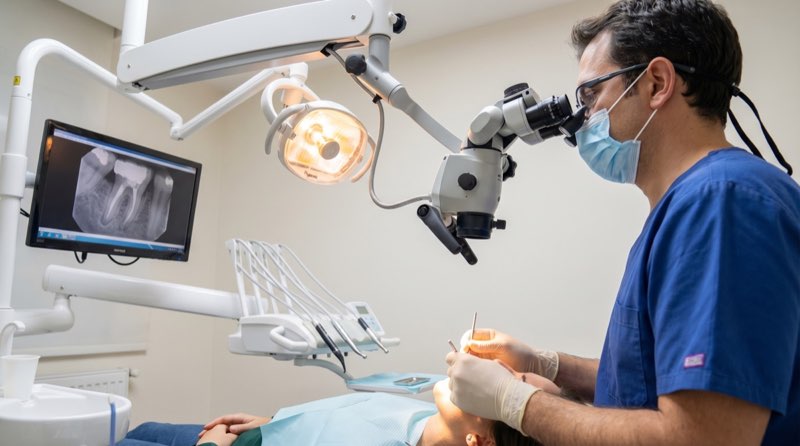
Step 1 — Digital Evaluation: We start with a complete intraoral scan and, when indicated, a cone beam 3D CT (tomography). This gives us a precise map of bone levels, root health, and how your bite distributes force. It's where we confirm whether the tooth is ready for a crown or needs prior work — and we tell you the answer clearly, with images you can see yourself.
Step 2 — Tooth Preparation: We reduce the tooth by approximately 1.0–1.5 mm on the biting surface and 0.8–1.2 mm on the sides. This is calibrated, minimally invasive work. We protect the biological space at the gumline — that invisible boundary where the crown margin sits. Cross that border and the gum responds the way a body attacks a splinter: chronic inflammation, bleeding, and eventually bone loss. We don't cross it. Preparation angles are always rounded, never sharp 90-degree edges that concentrate stress.
Step 3 — Digital Impression: Immediately after preparation, we scan the tooth with our intraoral scanner. No silicone trays, no gagging. A provisional crown is placed the same day to protect the prepared tooth while the final restoration is built.
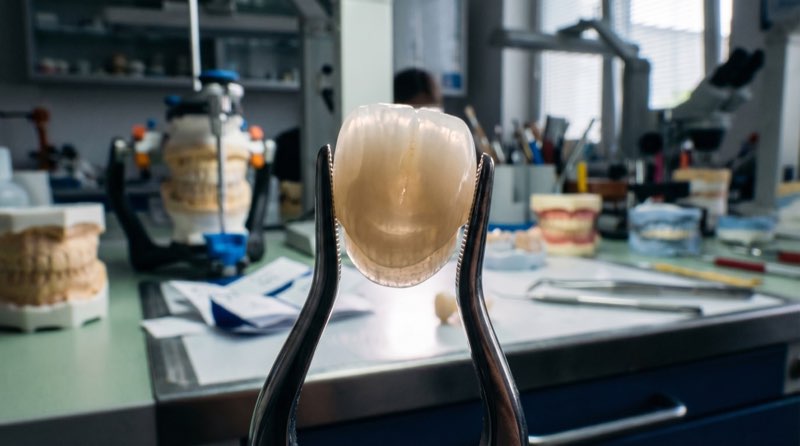
Step 4 — In-House Lab Fabrication: Our digital lab mills the crown from a certified zirconia block using CAD/CAM technology. We calibrate shade, shape, thickness, and occlusal contacts before anything is cut. For bruxism patients — and this is where I close the loop from earlier — we adjust the crown geometry to distribute forces more evenly across the bite, and we typically recommend a night guard alongside the crown to protect the investment long-term. Fabrication turnaround is 1–2 weeks.
Step 5 — Try-In and Final Cementation: We seat the crown, check the bite from multiple angles under different loads, make micro-adjustments, and cement definitively with resin cement. You leave with a restoration that fits exactly how it should — no pressure, no early contact, no post-op guessing.
For patients coming from outside CDMX — whether from other Mexican states or as part of dental tourism in CDMX — we often coordinate this into two strategic visits. That's worth asking about during your evaluation.
Questions Patients Always Ask Before Booking
Does getting a zirconia crown hurt?
The preparation is done under local anesthesia, so in practice you feel nothing during the procedure itself. There's usually mild sensitivity with the provisional crown on — that's normal and temporary. Once the final zirconia is cemented, that sensitivity resolves for most patients because zirconia has low thermal conductivity, meaning it doesn't amplify heat or cold the way metal does. It behaves more like natural tooth structure in that regard.
How long does a zirconia crown actually last?
The clinical evidence is solid: 95–98% survival rates at 10 years for monolithic zirconia crowns, according to meta-analyses in prosthodontic literature. In my clinic, I've seen well-maintained crowns hold up for 15 years and beyond. The key is gum health and professional cleanings every 4–6 months. The zirconia itself is extremely durable — what eventually fails, if anything, is the marginal gum tissue due to neglected hygiene, not the crown material.
Is zirconia worth it over a metal-ceramic crown?
For most cases, yes — and the data supports this. Metal-ceramic (porcelain-fused-to-metal) crowns have a ceramic layer that can chip, and they inevitably show a dark gum margin as years pass and gums naturally recede. Monolithic zirconia has no ceramic overlay to fracture, and it's completely metal-free, so no gray shadow ever appears. For patients who are also considering smile design work, zirconia integrates seamlessly with veneer aesthetics. The upfront investment is slightly higher, but the long-term outcome justifies it for the right patient.
Does DrDiente offer a guarantee on crowns?
Yes — a written guarantee against technical failure: fit issues, marginal defects, material problems. That's not standard practice across CDMX clinics. It should be. We stand behind our work because we control every step of it, from the digital diagnostic plan to the in-house lab fabrication to the final cementation. If something isn't right, we fix it.
Why Patients Across CDMX Choose DrDiente?
In my experience, patients don't keep choosing Clínica DrDiente just for the technology — though our 3D scanner, cone beam CT, and in-house digital lab do make a measurable clinical difference. They come back because they leave informed. They understand their own tooth. They saw their scan. They know what was done and why it was done that way.
Dr. Carlos Ariza brings 15 years of clinical experience in complex restorative dentistry in Mexico City. We document before-and-after outcomes on every dental crown case and follow up over time. Patients from Roma Norte, Polanco, and well beyond — including international patients exploring dental tourism in CDMX — choose us because the standard of care doesn't shift based on where you're from or what your budget is.
Both our Roma Norte and Polanco, CDMX locations run the same technology and the same protocols. Same intraoral scanner. Same in-house digital lab. Same Dr. Ariza reviewing every case before it goes to cementation.
Ready to find out if a zirconia crown is the right call for your tooth? An evaluation gives you a clear treatment plan, with no pressure to start treatment. Start there.
See real zirconia crown results at DrDiente Book my evaluation
Information from Clínica DrDiente
Aesthetic Dentistry & Oral Rehabilitation · COFEPRIS 2409132002A00145
This content is informational and is not a substitute for professional dental advice. Book an assessment for a personalized diagnosis.