What's Included in Professional Whitening at Clínica DrDiente?
At Clínica DrDiente, professional whitening starts with an honest diagnosis — not just a lamp and a gel. Dr. Carlos Ariza conducts a full periodontal evaluation, identifies the type and depth of your staining, and takes a standardized photographic record before recommending any protocol. You'll know exactly what you're getting into before anything touches your teeth.
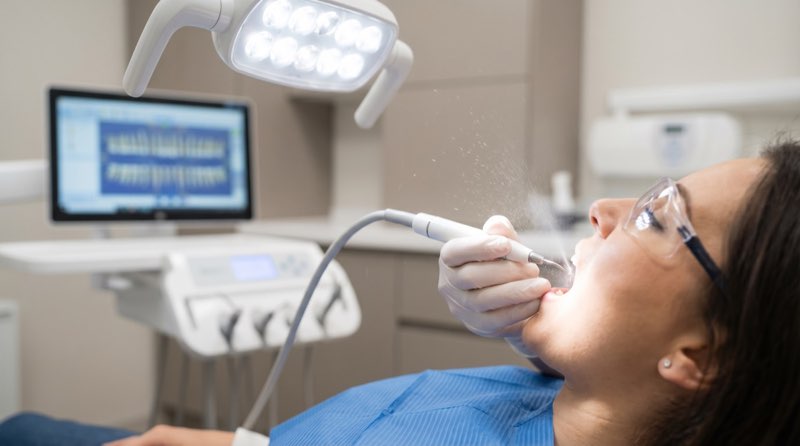
The treatment includes a professional cleaning one to two weeks before the whitening session, gum barrier protection and desensitizing agents during the procedure, one or two in-office whitening sessions with LED-activated hydrogen peroxide, and a custom-fit take-home tray kit for long-term maintenance. We document your before-and-after with the same photographic protocol we use for all smile design cases — so you have real, comparable proof of your result.
There's something most dentists don't tell you before that first whitening session — and it changes everything about how long your results actually last. I'll get to it in a moment.
How Much Does Teeth Whitening Cost in CDMX? — Real 2026 Prices
Prices vary depending on the protocol, the technology involved, and whether maintenance trays are included. Here are honest, current ranges:
- In-office whitening only: $2,500 – $4,500 MXN
- In-office + custom take-home trays (gold standard): $4,500 – $7,500 MXN
- Internal whitening for a non-vital, endodontically treated tooth: $1,500 – $3,000 MXN per tooth
At DrDiente, we offer an evaluation so you know exactly what protocol fits your case before starting treatment. We also have payment plans available — because a treatment that actually works shouldn't feel out of reach.
A word of caution: if you see whitening offers below $1,000 MXN with no prior evaluation, that's a red flag. Whitening without first diagnosing the cause of staining — or without checking for active decay and gum disease — is like painting over a rusty wall. It won't last, and it can cause real damage. Always verify your provider's professional license (cédula profesional SEP) before anything happens.
How Do I Know If I'm the Right Candidate?
The short answer: most adults with healthy gums and no untreated decay are candidates. But "most" isn't everyone, and I'd rather be upfront with you about the limits.
You're a good candidate if your gums are healthy — firm, pink, and not bleeding — you have no active cavities, your staining comes from coffee, tea, wine, or tobacco, and you're 16 or older.
You're not a candidate right now if you have active gum disease, untreated decay, are pregnant or breastfeeding, or have severe unmanaged sensitivity. Whitening gel can penetrate compromised enamel and cause intense pain — a risk no responsible dentist should take.
One thing that surprises many patients: crowns, ceramic veneers, and composite restorations don't change color with whitening. They're manufactured to a fixed shade. Whitening your natural teeth while leaving older restorations untouched can create visible color mismatches. There's an important exception to this, though — one that actually changes the entire treatment sequence — and I'll cover it in the FAQ section below.
For tetracycline staining or fluorosis, whitening alone usually isn't sufficient. These cases respond much more slowly, and I typically recommend starting with whitening and then evaluating whether porcelain veneers are the right next step. Setting realistic expectations from day one is non-negotiable for me.
The Step-by-Step Process at DrDiente
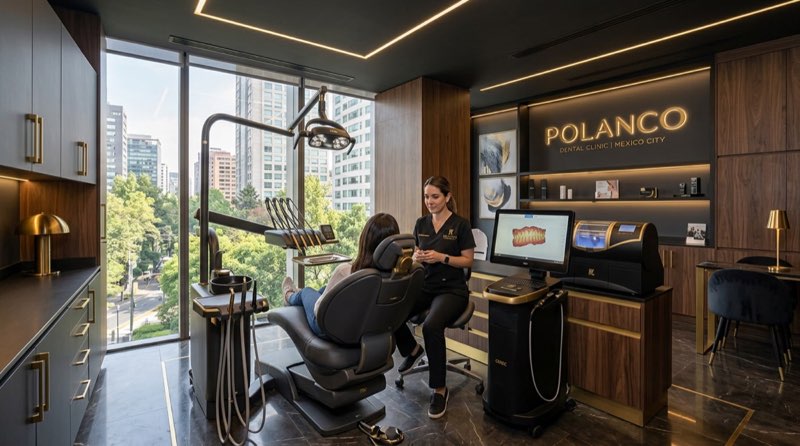
Here's exactly what happens when you start whitening treatment at Clínica DrDiente in Roma Norte or Polanco, CDMX:
Step 1 — Evaluation: Dr. Carlos Ariza reviews your gum health, identifies whether staining is extrinsic or intrinsic, and recommends the right protocol. We take baseline photos with our standardized photographic protocol — the same one used across all cosmetic cases at the clinic.
Step 2 — Professional cleaning: One to two weeks before your session, we do a thorough cleaning to remove tartar and biofilm. Whitening over plaque is like painting over dust — the result won't hold. This step alone has a visible impact on how vivid your final shade turns out.
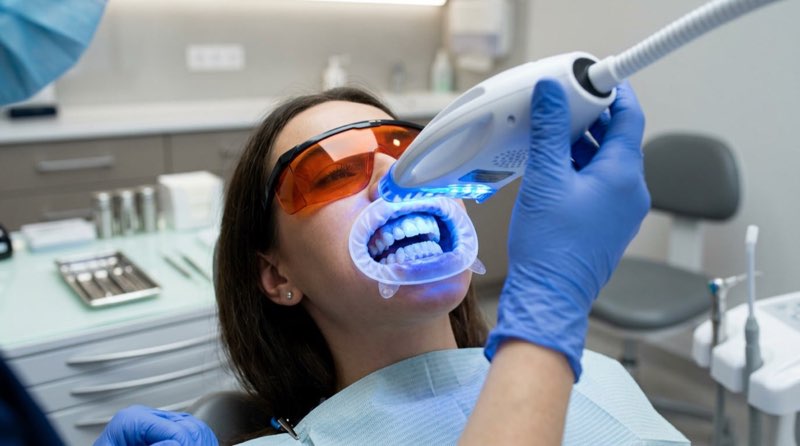
Step 3 — In-office whitening session: We protect your gums with a barrier gel, then apply 35–40% hydrogen peroxide activated with an LED light. The session lasts 60–90 minutes. Between each activation cycle, we apply potassium nitrate gel to manage sensitivity in real time — you're not just left in the chair hoping for the best.
Step 4 — Custom take-home trays: After your session, we take a digital intraoral scan — no goopy impressions — and fabricate precision-fit whitening trays in our own in-house laboratory. These are used for touch-ups at home, typically one to two nights per month to keep results sharp.
Step 5 — Follow-up photo record: Before you leave, we photograph your result with our standardized protocol. You walk out with a clear, comparable before-and-after — not just a feeling that something changed.
From evaluation to receiving your custom trays, the full process takes about two to three weeks. The in-office whitening session itself is a single appointment.
Now — back to what I mentioned at the start. What most dentists don't tell you before whitening is this: the 48–72 hours after your session are the most critical window. During this time, your enamel is temporarily more porous, and chromogenic molecules absorb more easily than usual. Coffee, red wine, tomato sauce, soy sauce, dark sodas — any of these can partially undo your result before it sets. This is the "white diet" window, and skipping it is the single most common reason patients feel disappointed a week later. Now you know. And that knowledge alone can protect weeks of treatment.
Questions I Always Get Before Scheduling
Does professional whitening hurt?
It can cause sensitivity — but not the kind of pain that should stop you. Between 38–70% of patients feel some tooth sensitivity during or shortly after the session, typically resolving within 24–48 hours. In my practice, we apply desensitizing agents before and after each activation cycle. Patients with naturally sensitive teeth can take ibuprofen 400 mg one hour before the appointment. Most people describe the sensation as brief electric zingers — noticeable, yes, but temporary and completely manageable.
How long do whitening results last?
Results from a professional in-office treatment typically last 18–36 months. The way I explain it to patients: the whitening is permanent in the sense that your teeth won't go back to exactly where they started — but your daily habits determine how long the brightness holds. Coffee, red wine, and tobacco are the main culprits. With an annual touch-up using your custom tray and carbamide peroxide gel, results can be maintained indefinitely without repeating the full in-office session.
I have a crown and older veneers — can I still whiten?
Here's the exception I mentioned earlier. If you have older composite restorations that have yellowed slightly over time, whitening your natural teeth can actually make those restorations more visible — because composite resin doesn't respond to peroxide. The correct sequence is: whiten first, then replace or update the composites to match your new shade. We plan this during the initial evaluation so nothing catches you off guard. As for porcelain crowns and ceramic veneers — these cannot be whitened at all. But if surrounding natural teeth have darkened since they were placed, targeted touch-up whitening can sometimes bring things back into visual harmony.
Are pharmacy whitening products worth trying first?
For being honest: not for meaningful results. Over-the-counter strips and whitening toothpastes typically improve color by 1–3 VITA shades at most. Professional in-office whitening achieves 6–14 shades of improvement — a difference documented in peer-reviewed literature, including the 2023 Cochrane Database review on dental bleaching. OTC products also carry a higher risk of uneven results and gum irritation from poorly fitting trays. If you've tried them and felt underwhelmed, that's not your imagination.
Is professional whitening safe for my enamel?
Yes — when performed by a licensed dentist with proper gum protection, pH-balanced agents, and sensitivity monitoring throughout. The American Dental Association endorses both in-office and supervised take-home whitening as safe and effective for adults. What's not safe is unsupervised high-concentration bleaching from spas or non-dental providers. I've seen chemical burns and enamel erosion from those situations. Verify your provider's cédula profesional before any procedure.
Why Patients Across CDMX Choose DrDiente
I'm Dr. Carlos Ariza, and I've been practicing dentistry in Mexico City for 15 years. The patients who come to Clínica DrDiente — in Roma Norte and Polanco, CDMX — aren't looking for the cheapest option. They're looking for a result that actually holds, explained by someone who tells them the truth about what's realistic and what isn't.
What makes the difference in practice: we don't do one-size-fits-all protocols. Every whitening case starts with a full diagnosis — periodontal evaluation, staining analysis, photographic record, and a real conversation about goals. We use professional-grade LED-activated systems with precise hydrogen peroxide concentration control. And because we have our own in-house digital laboratory — the same infrastructure we use for dental tourism CDMX packages and full-mouth rehabilitations — any complementary work that follows whitening is planned and executed with the same calibrated precision. No outsourcing, no communication gaps, no surprises.
In my experience, the patients most satisfied with whitening are the ones who came in with clear expectations, followed the post-care protocol, and showed up for their annual touch-up. Every single one of them. The results are real, and we photograph and document every case with standardized protocols so the evidence is there — not just a feeling.
For patients visiting from other cities or from abroad, whitening is often the first step of a broader cosmetic plan. Our dental tourism program bundles consultations, whitening, and follow-up procedures into a single optimized visit so you're not making unnecessary trips to CDMX.
See real whitening results at Clínica DrDiente Schedule my evaluation
Information from Clínica DrDiente
Aesthetic Dentistry & Oral Rehabilitation · COFEPRIS 2409132002A00145
This content is informational and is not a substitute for professional dental advice. Book an assessment for a personalized diagnosis.