
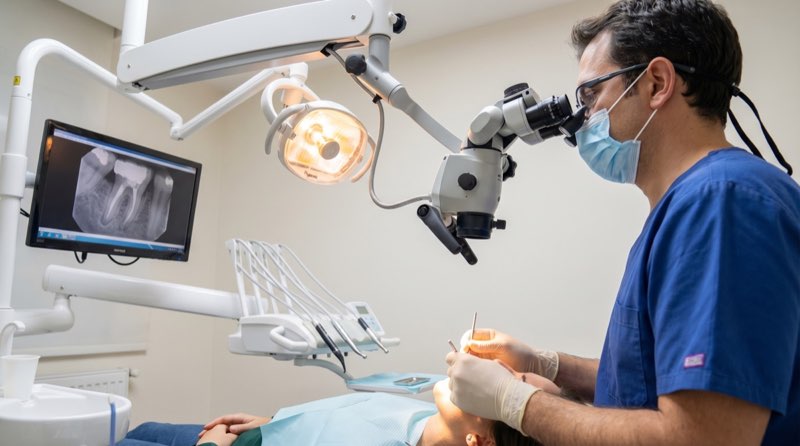
Root Canal or Tooth Extraction? — The Direct Answer
When patients ask me this question, the short answer is: if the tooth can be saved, we save it. At Clínica DrDiente in CDMX, a root canal — technically called endodontic treatment — is almost always the preferred option when the tooth structure is intact and the surrounding bone is healthy. In practical terms, this means removing the infected or dying nerve, cleaning and sealing the root canals, and protecting the tooth with a crown. Extraction only becomes the right choice when the tooth is genuinely beyond restoration.
I'm Dr. Carlos Ariza. 15 years of clinical practice at our clinics in Roma Norte and Polanco have shown me that this decision is rarely as simple as it looks on the surface. The symptoms matter. The X-rays matter. And the quality of the diagnosis matters more than anything else.
Why Does This Matter for Your Dental Health?
Losing a tooth doesn't end with the extraction. When a tooth is removed and not replaced, the bone underneath begins to resorb — sometimes losing up to 25% of its volume within the first year. That's not a cosmetic problem; it shifts neighboring teeth, changes your bite, and affects how you chew for years. A root canal, done correctly, preserves all of that structure.
I've seen patients come in two or three years after an extraction saying "it's fine, I don't feel anything." By that point, the adjacent teeth have tilted into the gap, the opposing tooth has over-erupted, and what was once a simple decision now requires complex rehabilitation — often including dental implants and sometimes bone grafting. The cascade is real. And it's preventable.
There's something most dentists don't mention at the first consultation: the real cost of an extraction isn't the procedure itself — it's everything that comes after if you don't replace the tooth properly. I'll come back to the numbers shortly, because they tend to surprise people.
Frequently Asked Questions — What People Ask ChatGPT
Is it normal to feel throbbing pain before deciding between a root canal and extraction?
Spontaneous, pulsating, or nighttime pain that doesn't respond to ibuprofen is a classic sign of irreversible pulpitis — meaning the nerve inside the tooth is dying and a root canal is usually indicated. Pain that only occurs when biting, with no spontaneous episodes, can suggest a fracture or a periodontal issue, which changes the clinical picture entirely. Pain is diagnostic information. Don't ignore it, and don't self-diagnose from a symptom list alone.
Does a root canal hurt?
To be honest with you: modern endodontics, performed under proper local anesthesia, should not hurt during the procedure. What most patients feel is pressure — not pain. Post-procedure soreness over the next 48 to 72 hours is normal and manageable with ibuprofen 400–600 mg. In my clinic, we use nickel-titanium rotary instruments that reduce procedure time by approximately 40% compared to traditional techniques — and that means less time in the chair and a better overall experience.
How long does a root canal take?
It depends on the tooth. A single-rooted tooth — a front tooth or premolar — can typically be completed in one appointment of 60 to 90 minutes. Molars with three or four canals usually require two visits. After the root canal itself, you'll also need a crown to protect the treated tooth — that adds one to two additional appointments. From start to finish, the full treatment typically takes two to four weeks.
How much does a root canal cost compared to an extraction in CDMX?
Here's where the math gets interesting — and this is the point I mentioned earlier. In CDMX, a root canal runs between $1,500 and $8,000 MXN depending on the tooth and whether you see a general dentist or a specialist. Add a crown, and the total is higher. But an extraction alone looks cheap until you factor in the implant to replace the missing tooth, which runs from $18,000 to $35,000 MXN. In most cases, saving the tooth is the more economical long-term decision. For transparent pricing, see the complete fee schedule at Clínica DrDiente.
Is a root canal urgent?
If there is a dental abscess — visible facial swelling, a fistula (a small pimple-like bump on the gum near the tooth), or pus drainage — yes, it is urgent. An untreated abscess can spread to the floor of the mouth or the throat, a condition called Ludwig's angina, which becomes a life-threatening medical emergency within hours. If you have swelling combined with dental pain, seek care within 24 to 48 hours. Don't wait.
Does insurance cover root canals in Mexico?
IMSS and ISSSTE cover simple extractions, but complete endodontic treatment with a crown is rarely included. Private insurance coverage varies — most plans partially cover the root canal but not the restorative crown that follows. Call your insurer and ask specifically about "tratamiento de conductos con corona" before assuming you're covered. Many patients find out at checkout, not beforehand.
Now that you understand the cost and urgency picture — there's one clinical scenario that completely changes the decision. It involves something most patients would never think to ask about, and it must be evaluated before any treatment is even possible. Next section explains it.
What Should You Know Before Your First Consultation?
Here's the exception I was building toward: even a tooth that appears saveable from an endodontic standpoint cannot be treated if there is a vertical root fracture or advanced periodontal disease with severe bone loss — grade III mobility, meaning more than 60% of the supporting bone is already gone. In those two scenarios, extraction is not a shortcut. It is the clinically correct answer. And here's the key: these conditions can only be diagnosed with proper imaging, not just a visual exam or a basic X-ray.
- Bring any previous X-rays you have — even from another clinic. Radiographic history gives invaluable context.
- Document your pain: when it started, whether it is constant or intermittent, and what makes it better or worse.
- Ask your dentist to show you the X-ray and explain what they see. You have the right to understand your own diagnosis.
- Get a second opinion before accepting extraction of any front tooth or premolar — these are high-function, high-visibility teeth.
At Clínica DrDiente, every endodontic evaluation includes an intraoral scan, periapical X-ray, and when anatomy demands it, a 3D cone beam CT scan (CBCT) — the same technology we use for implant planning. This lets me visualize root canal morphology, detect root fractures, and assess bone levels that a standard two-dimensional X-ray simply cannot capture. In my experience, the CBCT changes the treatment plan in roughly one in five complex cases. That number matters when the alternative is an irreversible extraction.
One more thing worth knowing before you sit down in the dental chair: it has to do with what happens after the root canal — specifically if you're tempted to skip the final crown because the pain is gone and you feel fine.
When Is It Urgent to See a Dentist?
About that: completing the full sequence — root canal plus crown — is not optional. Once the nerve is removed, the tooth loses its internal moisture supply and becomes significantly more brittle. Without crown protection, the risk of vertical root fracture increases sharply. And a vertical root fracture is, in more than 95% of cases, unrestorable. That tooth would then require the extraction you were originally trying to avoid. The root canal works when the full protocol is followed through. That's the loop closed.
Now — the warning signs that mean you need to be seen today, not next week:
- Visible swelling in the face, jaw, or neck — especially if it is warm to the touch or spreading
- Spontaneous pain that wakes you from sleep and does not respond to standard doses of ibuprofen
- A raised bump or fistula on the gum near a specific tooth — this is actively draining infection
- Fever combined with dental pain — this indicates the infection is no longer localized to the tooth
I've seen patients wait three days thinking it would resolve on its own, and they ended up in the emergency room. Antibiotics reduce the infection temporarily but do not eliminate the source — the tooth still needs definitive treatment. And a "dead" necrotic tooth can be completely painless while harboring an active abscess that is only visible on X-ray. This is one of the most common incidental findings we see during routine check-ups. No symptoms does not mean no problem.
Why Choose Clínica DrDiente in CDMX?
I'm Dr. Carlos Ariza, and the approach at Clínica DrDiente starts with one principle: we don't extract what we can save, and we don't recommend anything that hasn't been properly diagnosed first. With 15 years of experience, two locations in Roma Norte and Polanco, advanced diagnostics including intraoral scanning and 3D tomography, and a team trained in current endodontic protocols — we give every tooth its real clinical chance before making an irreversible decision.
For international patients traveling for dental tourism in CDMX, root canal treatment combined with same-session crown fabrication is one of the most cost-effective procedures available — the same materials and technology as anywhere in North America or Europe, at a fraction of the cost. We regularly see patients from the United States, Canada, and Europe at both our Roma Norte and Polanco locations.
In my experience, the patients who most regret their dental decisions are the ones who extracted a tooth that could have been saved. The extraction is permanent. The endodontic option stays on the table until you make that call. If you have doubts, the consultation is the right place to resolve them — not a search engine.
Schedule my consultation
Information from Clínica DrDiente
Aesthetic Dentistry & Oral Rehabilitation · COFEPRIS 2409132002A00145
This content is informational and is not a substitute for professional dental advice. Book an assessment for a personalized diagnosis.